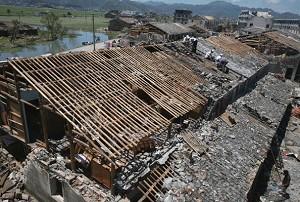
Typhoon Saomai, the most severe storm China has encountered in 50 years, destroyed ships and houses and caused mass casualties along the coastal regions of Zhejiang and Fujian provinces.
Most of the ships that had headed into shore to seek refuge were capsized during the storm with many people still aboard.
According to local residents, delays in communications and the complex nature of the rescue have left many people and hundreds of corpses still stranded in the ocean.
Reports from officials in Fujian Province claim that only 41 people died in Fuding City, the city hit hardest by the typhoon. However, telephone calls made by The Epoch Times to the region and other media reports reveal that many dead bodies are still floating in the sea and that the cries of family members can be heard throughout the city. The storm killed thousands of people, including naval officers and soldiers involved in the rescue.
A farmer from Fuding City said that the city looked horrific and that the government falsified their reports. He claims to have lost over one million yuan (US$ 125,000) in property from damage caused by the storm. The farmer also states that hundreds of bodies lay on the shore and even more are floating in the sea. “It will take several incinerators to cremate all the bodies,” he remarked.
In the afternoon of August 10, 2006, Saomai hit Fuding City and wreaked havoc for around four hours, and then another four hours in Zherong City. With wind speeds reaching as high as level 17, a Fuding government representative said, “Glass could be seen flying through the air, and no one was able to leave the building.”