


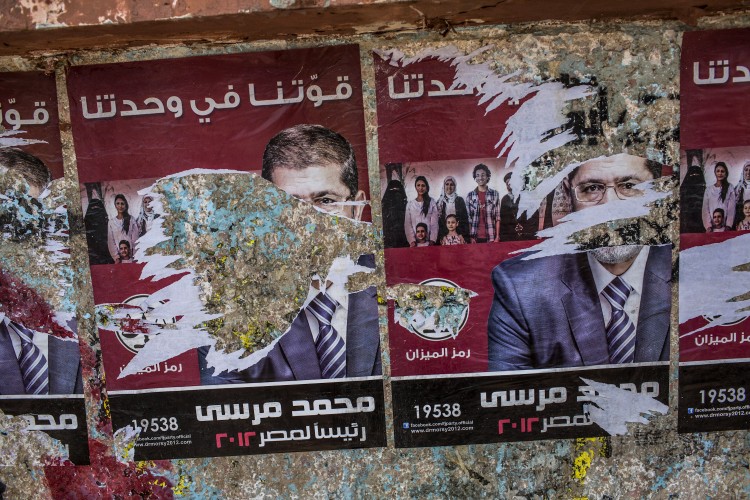
Egyptians cast their votes for the second and final day of voting on Sunday, as the country entered the last stages of its long-awaited but highly divisive presidential elections.
Voters face the choice between two contenders on opposite poles of the spectrum: Mohammed Mursi, the Islamist candidate for the Muslim Brotherhood, and Ahmed Shafiq, who briefly served as prime minister at the end of former President Hosni Mubarak’s rule.
Both candidates have divided opinion among Egyptians, with liberal groups calling for a boycott of the polls.
Ballots will be counted on Monday, and the result of the election will be decided by next Thursday.
The election comes after a week of political turmoil. The Supreme Constitutional Court ruled last Thursday that a parliamentary election last year, in which the Muslim Brotherhood won a majority of seats, was unconstitutional.
The house was dissolved on Friday, and a statement by the Muslim Brother described it as a “coup” by allies of the former regime.
There are 50 million eligible voters in Egypt, but in the first stage of the presidential elections in May, barely half voted.
There is expected to be an even lower turnout in this weekend’s polls. A political movement called the ‘voiders’ or ’mobteloon’ in Arabic, hope to persuade 10 million people to spoil their ballot papers. Their slogan is “No to military fascism and no to religious fascism.”
Many voting observers said turnout on Saturday was low, with smaller lines at polling stations than in the previous poll, Al Jazeera reported.
And many voters were not enthusiastic about each candidate.
“If Shafiq wins, there will be demonstrations, if Morsi wins, there will be demonstrations, at the end of the day, there will be a military coup,” Mohammed Gharbani, a construction worker, told the broadcaster, adding that he would vote for Morsi. “I see Mubarak in the face of Shafiq,” he said. .
The Epoch Times publishes in 35 countries and in 19 languages. Subscribe to our e-newsletter.


