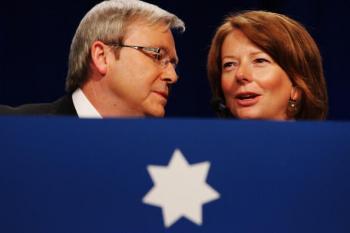
SYDNEY, Australia—Julia Gillard has it, while Kevin Rudd didn’t. So say the pundits in analysing the historic move by Australia’s Labor Party in removing Kevin Rudd as their leader and, accordingly, as prime minister of Australia.
The nation has been in shock since the announcement of Kevin Rudd’s demise on Thursday June 24, with the media finger pointing, accusing and fear-mongering about the unions taking over.
Political analysts, however, are clear—Kevin Rudd had slipped so badly in the polls that Labor was fighting for its survival.
“We know that Labor was going to lose the election unequivocally in both the reported opinion polls and in their own internal party polls, which showed that they were headed, not just for defeat, but a for a resounding defeat,” said Dr Haydon Manning, Associate Professor in the School of Political studies at Flinders University in South Australia. “Their only alternative was to go to the Deputy Prime Minister Julia Gillard.”
Commenting on the swiftness of the move and the fact that it had happened before Kevin Rudd had completed his first 3-year term as Prime Minister, Dr Manning said that when a leader slips badly in the polls, “they are in grave trouble”.
“It is just the nature of domestic politics,” he told The Epoch Times.
It is also the nature of leadership. Much analysis has gone into Kevin Rudd’s style of leadership and it appears that it was this that let him down.
Mr Rudd did not understand how to run a government or indeed, how to work collaboratively with his colleagues, says Dr Manning.
“He had no idea. People were suspicious of that very early in his prime ministership and, of course, it took time for that suspicion to grow into raw fear about losing the election.”
Ben Eltham, political analyst for New Matilda, says Mr Rudd did not make the effort to cultivate back benchers and office bearers, leaving him without a support base when he most needed it.
“He has been disorganised, rude and at times peremptory—not a recipe for personal support,” Mr Eltham wrote.
Dr Norman Abjorensen, lecturer in politics at ANU, was more specific.
“Rudd’s absorption in micromanagement verged on the obsessive. He could master detail, as a former bureaucrat should, but where was the big stuff? … Where was the generalship we look for in a leader, the vision splendid?” he wrote on his blog.
It is true that during his leadership, Mr Rudd’s Government apologised to the Stolen Generation, evaded the global recession, dismantled Work Choices and reformed the health system. And indeed, as fate would have it, Kevin Rudd exhibited the statesman-like qualities in his parting speech that had been so lacking.
Humble and gracious in defeat, his speech was heart-wrenchingly moving, passionate and articulate, but only on his last day as prime minister did theAustralian people get a chance to see the very human side of Kevin Rudd.