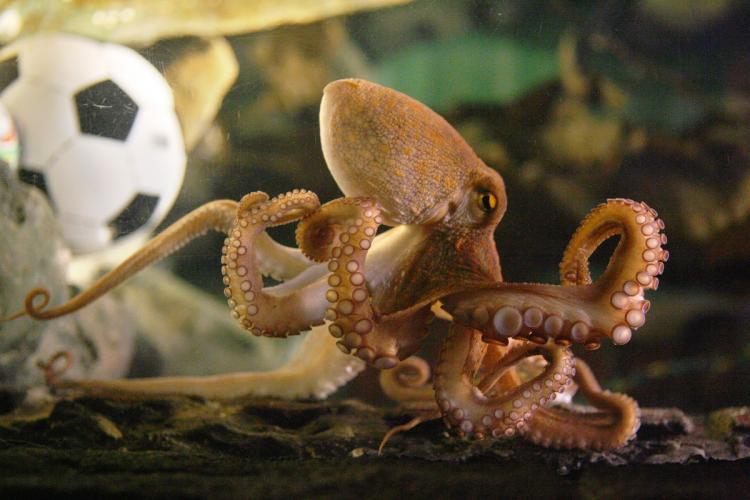
The New Year is a time for looking back and looking forward. Perhaps the oddest news story in 2010 was about, among other things, our desire to look forward—the story of Paul the prognosticating octopus.
Paul, a brown octopus who was housed in the Oberhausen Sea Life Center in Germany (he died of natural causes in October), correctly chose the winners in the seven matches played by Germany in the World Cup and the winner of the World Cup final, Spain.
To speak more precisely, before each match, Paul chose to eat a mussel from one of two transparent boxes, each marked with a soccer team’s national flag. The mathematical odds of making 8 such correct choices is 1 in 256.
As the correct choices improbably followed one upon another, interest in the cephalopod soared. TV networks began covering the sessions at which he made his choice and soccer fans worldwide became Paul’s fans.
For two months this past summer Paul was a sensation—he ended up overshadowing the stars who actually played in the World Cup.
Whether Paul’s choice of a meal amounted to a choice of a winner in a soccer match might be debated. But soccer fans and others caught up in the story believed this mollusk had the power to see into the future.
Humankind has always chafed under the limitations of our condition. As for seeing the future, we see “through a glass darkly” or not at all.
Of course, the desire to know what is going to happen next is not hard to understand. Those who placed bets on the basis of Paul’s predictions made money.
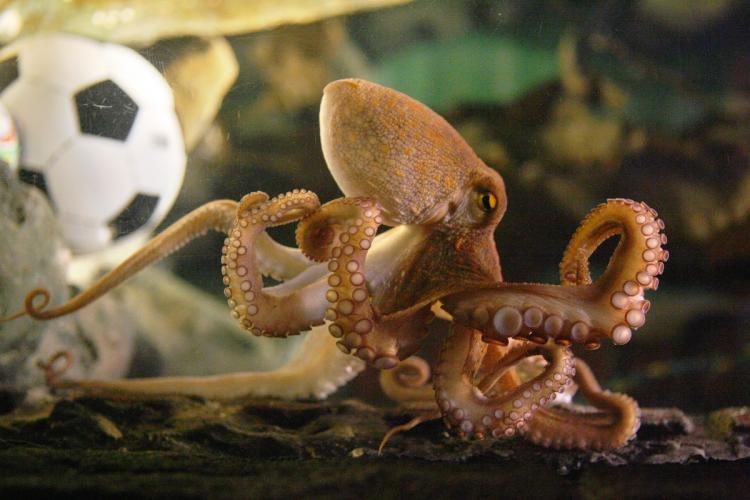
Paul, a brown octopus who was housed in the Oberhausen Sea Life Center in Germany (he died of natural causes in October), correctly chose the winners in the seven matches played by Germany in the World Cup and the winner of the World Cup final, Spain.
To speak more precisely, before each match, Paul chose to eat a mussel from one of two transparent boxes, each marked with a soccer team’s national flag. The mathematical odds of making 8 such correct choices is 1 in 256.
As the correct choices improbably followed one upon another, interest in the cephalopod soared. TV networks began covering the sessions at which he made his choice and soccer fans worldwide became Paul’s fans.
For two months this past summer Paul was a sensation—he ended up overshadowing the stars who actually played in the World Cup.
Whether Paul’s choice of a meal amounted to a choice of a winner in a soccer match might be debated. But soccer fans and others caught up in the story believed this mollusk had the power to see into the future.
Humankind has always chafed under the limitations of our condition. As for seeing the future, we see “through a glass darkly” or not at all.
Of course, the desire to know what is going to happen next is not hard to understand. Those who placed bets on the basis of Paul’s predictions made money.