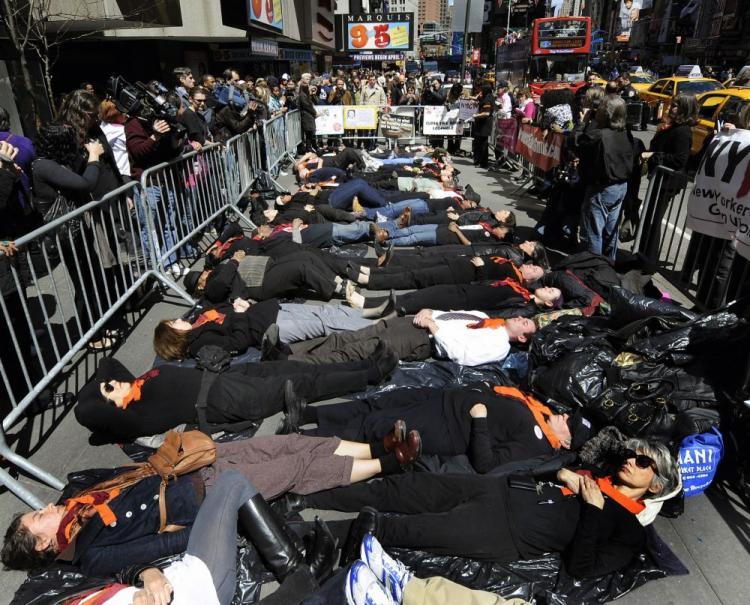
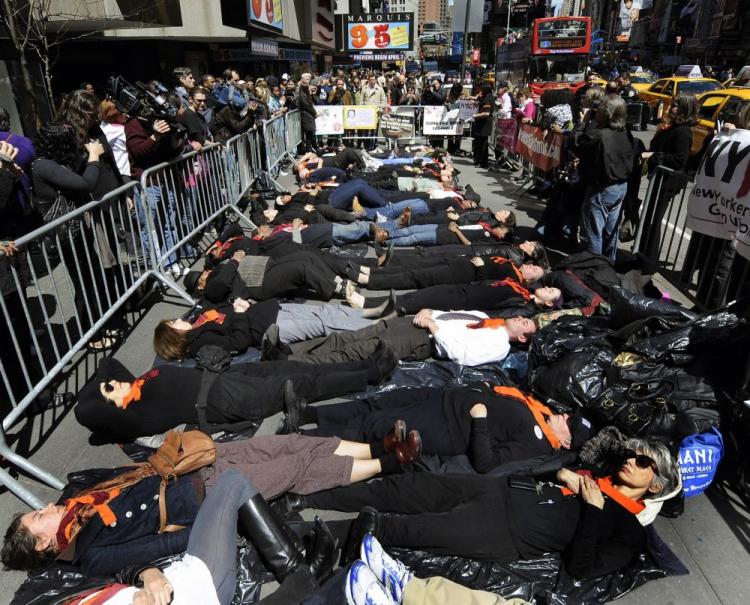
NEW YORK—Times Square was the site of dozens of victims of gun violence on Thursday. Though the deaths were simulated, the 32 bodies strewn across the sidewalk along Broadway replicated the number of deaths at the Virginia Tech shootings that occurred on the same date, April 16, two years ago. It also happens to be the number of gun fatalities per day in the U.S.
Monday, April 20 will be the 10th anniversary of the Littleton, Colorado shootings in which two Columbine high school students roamed the halls of their school and gunned down 10 students and one teacher before killing themselves.
Jackie Hilley is a member of New Yorkers Against Gun Violence and helped to organize the event on Thursday. Other participants included students, advocates, and victims of gun violence in their families. Most were local New Yorkers.
“I’m a child advocate, and a former prosecutor for the Manhattan DA’s office, so I come at it from two different angles.” Said Ms. Hilley “One is having had a lot of victims in my office for all those years I worked in the Manhattan DA’s office, and the second angle is when I was working as a child advocate in Westchester I did a study on the public health approach to gun violence, which is the approach that is promoted by the Harvard School of Public Health.”
Ms. Hilley explained that the Harvard study considers that the number of gun deaths in the U.S. each year is 30,000 people, and that if you have 30,000 people dying of any one thing in a year, be it cancer, or poisoning, or whatever, it is a public health issue.
The Harvard study approaches gun violence with available public health models. This approach seeks to consider the impact on public health and safety, and puts aside issues of second amendment rights, and focuses directly on gun violence as a public health issue.
In a study done in San Francisco, California, it was determined that 70 percent of victims of gun violence were born in public hospitals and use public hospitals as a primary source of health care. This information was then used to determine that public hospitals are a good place to get in touch with people who are victims of gun violence, and as a means to talk to them about ways to avoid gun violence. It is used as a way to educate and change behavior.
Another angle that the Harvard study considered is that of the 30,000 deaths by gun violence in the U.S. each year, at least 17,000, or more than half, are suicides. This information can be directly transferred into legislation and mental health policy that protects at risk individuals, such as those that are being treated for depression, who can be asked in a questionnaire if there are any guns in their home, and those guns can be removed.
Bringing the issue into a criminal justice model, a law in Connecticut that has been on the books for 10 years allows police officers to confiscate guns from people that have been reported to the police as behaving irrationally, the police have a right to take their guns, and within 14 days there will be a hearing in front of judge, at which time it will be decided if the guns will be returned. The Connecticut police have had about 230 cases of enacting this law over the last ten years, and have confiscated approximately 1,700 guns.
“Which will give you a good idea of the per capita possession of weapons,” said Ms. Hilley. “The guns are out there for sure.”
Monday, April 20 will be the 10th anniversary of the Littleton, Colorado shootings in which two Columbine high school students roamed the halls of their school and gunned down 10 students and one teacher before killing themselves.
Jackie Hilley is a member of New Yorkers Against Gun Violence and helped to organize the event on Thursday. Other participants included students, advocates, and victims of gun violence in their families. Most were local New Yorkers.
“I’m a child advocate, and a former prosecutor for the Manhattan DA’s office, so I come at it from two different angles.” Said Ms. Hilley “One is having had a lot of victims in my office for all those years I worked in the Manhattan DA’s office, and the second angle is when I was working as a child advocate in Westchester I did a study on the public health approach to gun violence, which is the approach that is promoted by the Harvard School of Public Health.”
Ms. Hilley explained that the Harvard study considers that the number of gun deaths in the U.S. each year is 30,000 people, and that if you have 30,000 people dying of any one thing in a year, be it cancer, or poisoning, or whatever, it is a public health issue.
The Harvard study approaches gun violence with available public health models. This approach seeks to consider the impact on public health and safety, and puts aside issues of second amendment rights, and focuses directly on gun violence as a public health issue.
In a study done in San Francisco, California, it was determined that 70 percent of victims of gun violence were born in public hospitals and use public hospitals as a primary source of health care. This information was then used to determine that public hospitals are a good place to get in touch with people who are victims of gun violence, and as a means to talk to them about ways to avoid gun violence. It is used as a way to educate and change behavior.
Another angle that the Harvard study considered is that of the 30,000 deaths by gun violence in the U.S. each year, at least 17,000, or more than half, are suicides. This information can be directly transferred into legislation and mental health policy that protects at risk individuals, such as those that are being treated for depression, who can be asked in a questionnaire if there are any guns in their home, and those guns can be removed.
Bringing the issue into a criminal justice model, a law in Connecticut that has been on the books for 10 years allows police officers to confiscate guns from people that have been reported to the police as behaving irrationally, the police have a right to take their guns, and within 14 days there will be a hearing in front of judge, at which time it will be decided if the guns will be returned. The Connecticut police have had about 230 cases of enacting this law over the last ten years, and have confiscated approximately 1,700 guns.
“Which will give you a good idea of the per capita possession of weapons,” said Ms. Hilley. “The guns are out there for sure.”