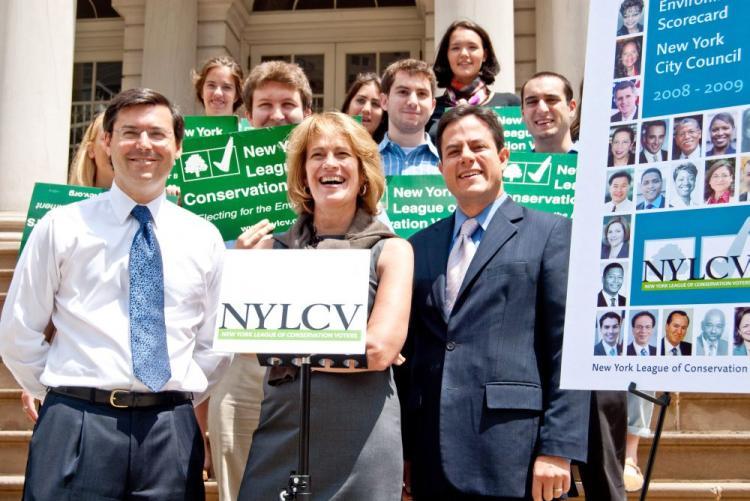
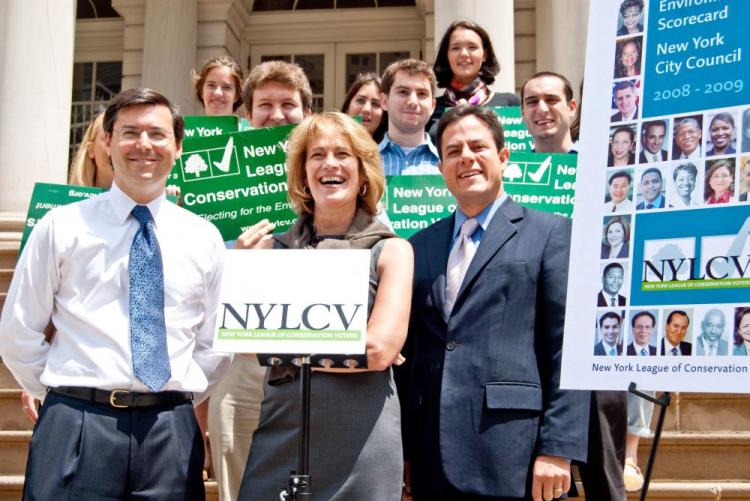
The New York League of Conservation Voters (NYLCV) announced on Wednesday the 2008 - 2009 Environmental Scorecard of the New York City Council, which evaluates “city council members’ commitment for the environment,” said Marcia Bystryn, the president of NYLCV.
According to Bystryn, the NYLCV consulted other environmental groups and decided on assessing the councilors’ contribution according to their actions on 13 bills related to energy efficiency, sustainability, and water and air quality. The councilors get points for co-sponsoring or voting on these bills. Those who supported all 13 bills got a score of 100.
The city council has made progress in improving the environment in the past few years. This year, the average score is 68, compared to 45 in 2006. Among the 50 councilors, 7 got a score of 100, and the councilors who got high scores are not limited to those representing Brooklyn and Manhattan, but all boroughs of the city, according to Dan Hendrick, the communications director of NYLCV.
Bystryn says that the scorecard can tell the public and voters which councilor is doing his/her job well, and Council member David Yassky added that it can pressure councilors to protect the environment.
Yassky, who got a 100 in the assessment, said that we need to care about the environment, because currently, one out of eight citizens in the New York State has asthma. When the economy is bad, people tend to focus on the economy and forget about the environment, he said, but the economy and the environment actually “go hand in hand.” Without being environmentally friendly, the economy would not be sustainable.
Council member Daniel Garodnick, who also got a 100, is most concerned about global warming and the climate change that it brings. Since 1880, the temperature in the state of New York has increased four degrees Fahrenheit, and according to NASA, the sea level is raising at a rate of 0.27 cm/year.
The City Council plans to reduce greenhouse gas emission by 30 percent by 2030, and Garodnick said that the Green Buildings package, which can improve energy efficiency in buildings, can play a big role in accomplishing this.
According to Bystryn, the NYLCV consulted other environmental groups and decided on assessing the councilors’ contribution according to their actions on 13 bills related to energy efficiency, sustainability, and water and air quality. The councilors get points for co-sponsoring or voting on these bills. Those who supported all 13 bills got a score of 100.
The city council has made progress in improving the environment in the past few years. This year, the average score is 68, compared to 45 in 2006. Among the 50 councilors, 7 got a score of 100, and the councilors who got high scores are not limited to those representing Brooklyn and Manhattan, but all boroughs of the city, according to Dan Hendrick, the communications director of NYLCV.
Bystryn says that the scorecard can tell the public and voters which councilor is doing his/her job well, and Council member David Yassky added that it can pressure councilors to protect the environment.
Yassky, who got a 100 in the assessment, said that we need to care about the environment, because currently, one out of eight citizens in the New York State has asthma. When the economy is bad, people tend to focus on the economy and forget about the environment, he said, but the economy and the environment actually “go hand in hand.” Without being environmentally friendly, the economy would not be sustainable.
Council member Daniel Garodnick, who also got a 100, is most concerned about global warming and the climate change that it brings. Since 1880, the temperature in the state of New York has increased four degrees Fahrenheit, and according to NASA, the sea level is raising at a rate of 0.27 cm/year.
The City Council plans to reduce greenhouse gas emission by 30 percent by 2030, and Garodnick said that the Green Buildings package, which can improve energy efficiency in buildings, can play a big role in accomplishing this.