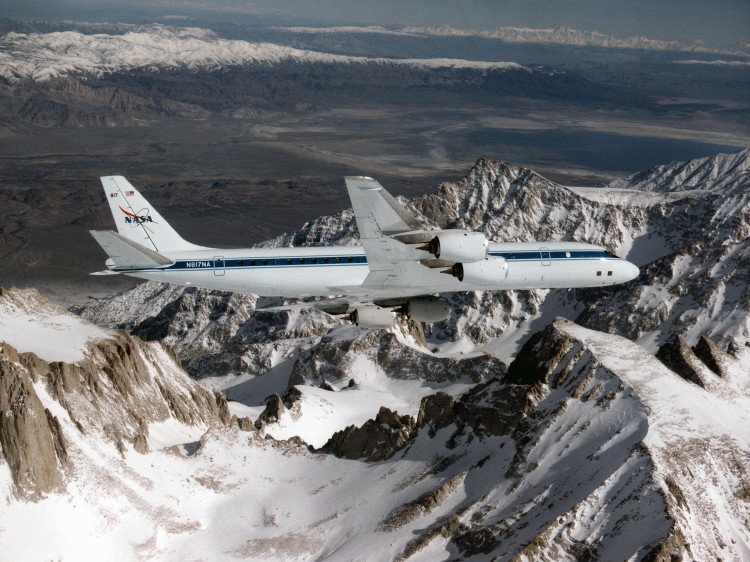
An air-borne science laboratory began flying in the skies over Ontario this week as part of NASA’s experiments ahead of the launch of its precipitation measurement satellite mission in 2014.
With help from Environment Canada, NASA is using its new radar technology aboard a DC-8 plane to measure snow fall in Ontario from Jan. 17 to Feb. 29.
The instruments simulate the measurements that will be taken by the space agency’s Global Precipitation Measurement (GPM) satellite mission.
“The DC-8 gives us essentially what the satellites do see, it has the remote sensing instruments like a satellite uses,” says Gail Skofronick-Jackson, the deputy mission scientist for the GPM mission.
After its launch, the GPM satellite will be providing worldwide rain and snow observations every three hours. The mission sets a new standard for precipitation measurements from space and marks a first for detecting snow fall from space.
While satellites have been able to estimate rain precipitation from space for many years, the technology has been behind in detecting snow from space, explains Skofronick-Jackson.
The field experiment in Canada is meant to improve the satellite’s capabilities to measure snow fall and test the ground validation capabilities.
As part of the experiment, the NASA DC-8 will fly above the clouds, simulating what the satellite would see, while two other aircrafts will fly through the clouds.
“What happens is that you get a 3-dimensional view of the cloud, and that way we can improve our models, we can improve our algorithms, because we know a relationship between what the aircraft sees remotely and what the DC-8 sees remotely from the radar, and what you see directly in the cloud itself,” Skofronick-Jackson says.
The DC-8 will also fly over a network of gauges and sensors installed at Environment Canada’s Centre for Atmospheric Research Experiments located 100km north of Toronto multiple times, helping scientists match snow measurements in the air and on the ground with the satellite’s measurements.
Skofronick-Jackson says frequent snowstorms weren’t the only reason that Canada was chosen for the field experiment.
“We had an experiment with the Canadians back in the winter of 2006 and 2007 and it was highly successful, so we wanted to partner with them again,” she says.
Other Canadian organizations taking part in the experiment include the National Research Council of Canada, McGill University, and the University of Manitoba, which are participating with funding from the Canadian Space Agency.
One of the goals of the GPM mission, says Skofronick-Jackson, is to integrate the measurements into useful applications and to utilize them to benefit society.
“How can we understand what’s falling out of the cloud in terms of rain and snow and how does it flow through our streams, and how might it cause floods or landslides,” she says as examples of how the measurements can be useful.
“So we have a field campaign planned, we’re looking at 2013, 2014, for more of these integrated applications studies, so we would take measurements over a particular stream basin and see how the rain flows through, and can we validate those measurements from space as well as from ground.”