

Racing icon Lotus will join Honda and Chevrolet in supplying engines for IndyCar starting in 2012.
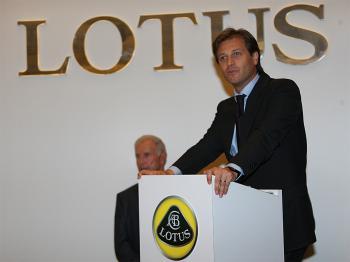
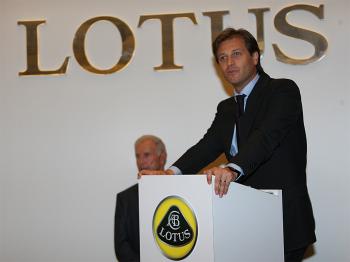
In an announcement broadcast live online from the Los Angeles Auto Show, Lotus Group CEO Dany Behar revealed that Lotus will offer both engines and aerokits for the new IndyCar chassis which will begin competition in 2012.
“What we are trying to do with the Lotus brand is to pay justice to our heritage and our past,” Behar said, “and our heritage is all about motor racing. our road cars should have a significant connection with motor sports. the main supporting activity for Lotus sports cars will be, as it was always, motor racing.”
Lotus Group, which builds several small sports cars for road use, is part of IndyCar history. 1965 Lotus won the Indy 500 with the Lotus 25, the first mid-engined car to win the race, effectively ending the front-engined roadster era. The Lotus 25 finished second in 1966 and 1967.
Lotus returned with its 4-wheel-drive turbine-powered Type 56 in 1968, but the car’s engine failed while leading the race.
Lotus is part of IndyCar history. 1965 Lotus won the Indy 500 with the Lotus 25, the first mid-engined car to win the race, effectively ending the front-engined roadster era. The Lotus 25 finished second in 1966 and 1967.
Lotus returned with its 4-wheel-drive turbine-powered Type 56 in 1968, but the car’s engine failed while leading the race.
The return of Lotus, a name revered by racing fans around the world, is a huge boost to IndyCar, which had been struggling to rebuild after uniting with a competing series in 2008. In order to survive financially, IndyCar was forced to mandate a single chassis and engine for the whole field—what is known as “spec” racing—and the decision, though it saved the series, was not popular.
As IndyCar CEO Randy Bernard explained, “Last March we learned really quick what the fans wanted: they wanted to see the spec series go away. That was the Number One thing the fans said.
“We were very excited to announce last week that it would no longer be a spec series with two engines and we are even more proud to announce to say that there will be three engines in 2012.”
Chevrolet announced their plans to build an engine and aerokit for the 2012 season last week. This means the series will now have three chassis- and engine suppliers vying for the championship—exactly the kind of technical competition the fans had asked for.
In an announcement broadcast live online from the Los Angeles Auto Show, Lotus Group CEO Dany Behar revealed that Lotus will offer both engines and aerokits for the new IndyCar chassis which will begin competition in 2012.
“What we are trying to do with the Lotus brand is to pay justice to our heritage and our past,” Behar said, “and our heritage is all about motor racing. our road cars should have a significant connection with motor sports. the main supporting activity for Lotus sports cars will be, as it was always, motor racing.”
Lotus Group, which builds several small sports cars for road use, is part of IndyCar history. 1965 Lotus won the Indy 500 with the Lotus 25, the first mid-engined car to win the race, effectively ending the front-engined roadster era. The Lotus 25 finished second in 1966 and 1967.
Lotus returned with its 4-wheel-drive turbine-powered Type 56 in 1968, but the car’s engine failed while leading the race.
Lotus is part of IndyCar history. 1965 Lotus won the Indy 500 with the Lotus 25, the first mid-engined car to win the race, effectively ending the front-engined roadster era. The Lotus 25 finished second in 1966 and 1967.
Lotus returned with its 4-wheel-drive turbine-powered Type 56 in 1968, but the car’s engine failed while leading the race.
No More ‘Spec’ Series
The return of Lotus, a name revered by racing fans around the world, is a huge boost to IndyCar, which had been struggling to rebuild after uniting with a competing series in 2008. In order to survive financially, IndyCar was forced to mandate a single chassis and engine for the whole field—what is known as “spec” racing—and the decision, though it saved the series, was not popular.
As IndyCar CEO Randy Bernard explained, “Last March we learned really quick what the fans wanted: they wanted to see the spec series go away. That was the Number One thing the fans said.
“We were very excited to announce last week that it would no longer be a spec series with two engines and we are even more proud to announce to say that there will be three engines in 2012.”
Chevrolet announced their plans to build an engine and aerokit for the 2012 season last week. This means the series will now have three chassis- and engine suppliers vying for the championship—exactly the kind of technical competition the fans had asked for.


