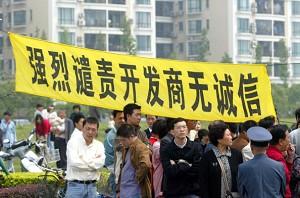
After the 1989 Tiananmen Square Massacre, the Chinese communist officials developed a new way to make windfall profits—the “land enclosure movement”. In recent years numerous peasants have been deprived of their fields, and city dwellers have been forced to relocate, receiving only very moderate, if any, compensation. These Chinese people are victims of the greed of their local governments, who traded the people’s land for political achievements and financial profits.
Early June, the Chinese Ministry of Land and Resources issued several orders, one after another, prohibiting illegal trade. The Ministry first banned issuing new land permits for building villas, and then announced that illegal land development is so rampant that at least 60 percent of recent urban land development projects involve illegal land acquisition. In some cities, this number is as high as 90 percent, according to the Ministry. To demonstrate its determination in implementing order in the land market, the Ministry went as far as imposing a minimum number of land related cases for each province to solve.
The background behind the Ministry’s new actions is the increasing mass protest of Chinese peasants against land enclosure by local governments. On June 8, the Guangdong government arrested seven peasant representatives for “extortion” after a large-scale protest against illegal land acquisition in Sanzhan Harbor of Foshan City, Guangdong Province.
Government Key Force in Land Trade Abuse
The key to understanding these conflicts involves the idiosyncrasy of the Chinese real estate market and the embarrassing role the local governments play in this market. Besides real estate developers and house buyers, the Chinese real estate market also involves two other parties, namely, the original owners of the land (peasants deprived of their fields, and city dwellers forced to relocate) and local governments who seized the land from the original owners. The central government becomes the arbitrator in land related conflicts.