

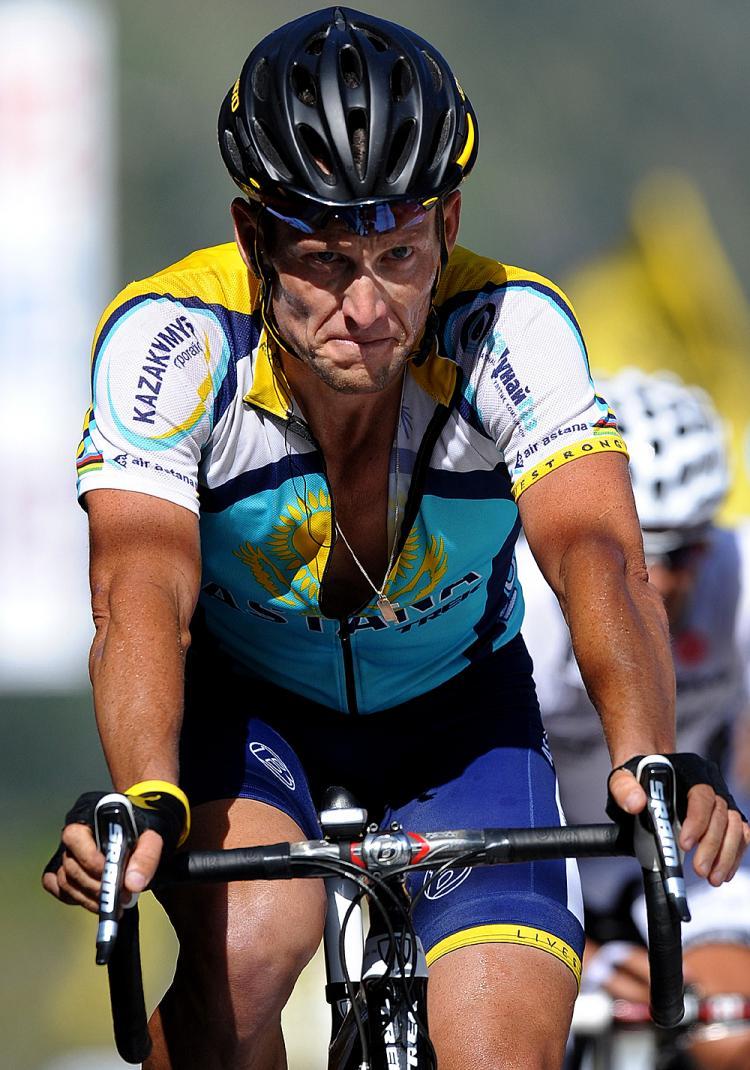
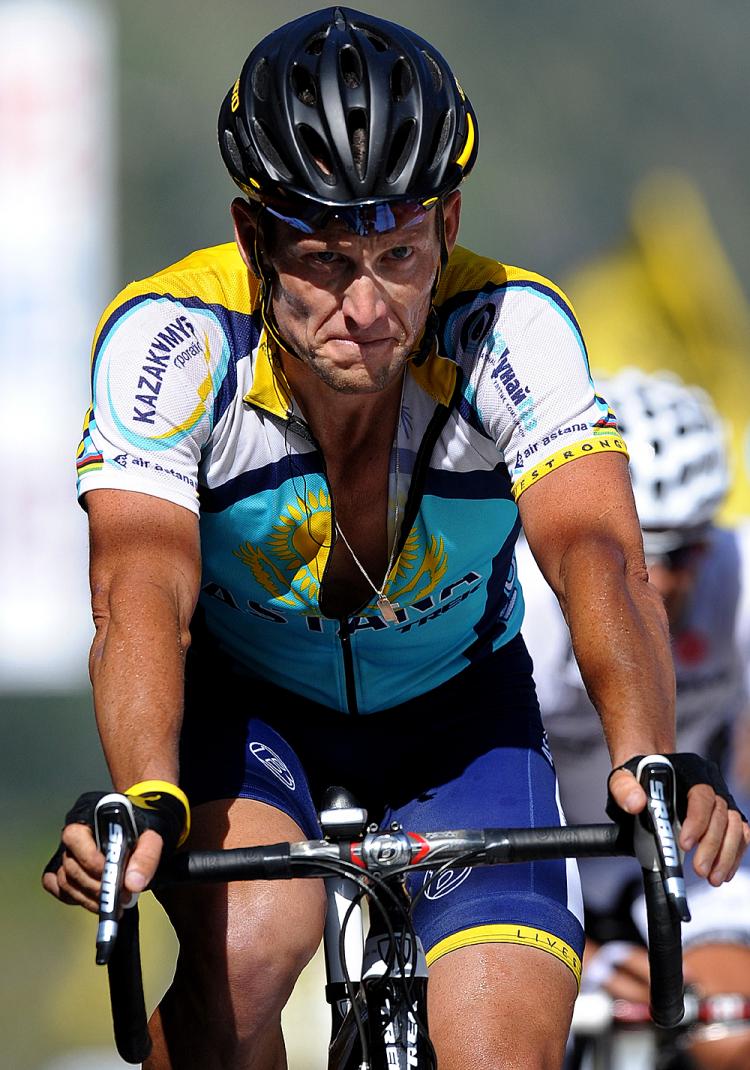
When, on that first alpine stage, Team Astana rider Alberto Contador attacked, only one rider followed him. And it wasn’t Lance Armstrong.
When the next rider pulled away and then the next pulled away, Lance Armstrong couldn’t follow them. Lance rode steadily and stolidly to finish in ninth place, helped along by teammate Andréas Klöden, as any older man might be helped by a good youth who saw him struggling.
Lance Armstrong is a competitor. He battled cancer. He battled himself, the weather, the mountains, and 179 other riders to win the toughest bicycle race in the world—seven times.
He has competed in countless other bike races. He has raced mountain bikes, run marathons. He has competed with himself to do better, and with others, to be better.
But Lance Armstrong is also a realist. To make the most of one’s innate abilities, one must be brutally honest about what one can and cannot do, or one will never know what to strengthen, what to maximize, and what to compensate for.
Without facing reality, one cannot pace oneself. Without being a realist, Lance Armstrong could never have been such a successful competitor.
When Lance Armstrong said after Stage 15 of the Tour de France, that he “wasn’t on par with what’s required to win the Tour,” he was being brutally realistic. On that day, he really wasn’t on par to win the Tour.
Perhaps that was the time for many of his fans to realize that Lance Armstrong isn’t a legend—he is a legendary human being. He is the stuff of cycling legend and the inspiration for many dreams, but he is not a legend or a dream.
He is a man who came back to one of the toughest sports in the world, three years after retiring at an age most pro cyclists would consider a little late for retirement.
He is a gifted athlete with a strong will and a tremendous work ethic, who will sacrifice himself for what he wants, who will give his all to get it.
But he is still a human being, and as a realist, he knows he has limits. On the climb to the town of Verbiers, he met some of those limits. As a realist, he faced them with equanimity.
He didn’t have what it took that day. He said, “For me, that’s the reality; that’s not devastating news or anything.”
But right before he said that, when asked if he could still win the Tour, he said, “It’ll be hard.”
Not, “No.” Not, “I can’t do it.”
But instead, “It’ll be hard.”
Alberto Contador took the lead in the Tour de France by a margin of one minute and 37 seconds over second place rider, Lance Armstrong.
I doubt Lance Armstrong can win the Tour de France again. There are too many hard climbs, and in the time trial—once his specialty—he faces stiff competition from Contador, who beat him soundly in the first individual time trial.
I cannot see him gaining time over the many grueling stages yet to come. Though his will is strong as ever, his legs are a decade older than the competition’s.
But I will not give up my tiny, foolish hope that Lance might surprise me. Even when it seems hopeless, and the realist in me recognizes that there is no way he can make up the time, no way to push himself harder … I will always have a small part of my mind saying, “Go, Lance! You can do it.”
I can and should, but will not, give up on Lance Armstrong.
“It’ll be hard.”
I can assure you, for all his brutal realism, Lance Armstrong has not given up on himself. He is too much the competitor.


