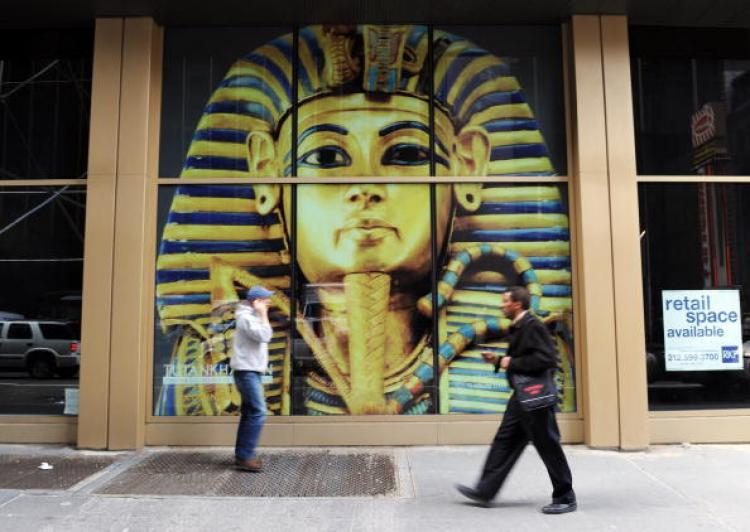
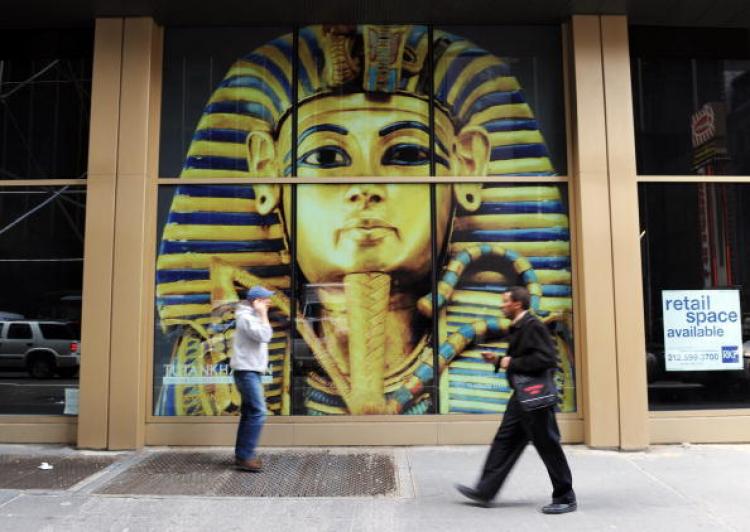
A King Tut Exhibition, officially the “Tutankhamun and the Golden Age of the Pharaohs” produced by National Geographic, opened Thursday at the Discovery Times Square Exposition in New York City. It will stay until Jan. 2, 2011.
Visitors to the exhibit can examine artifacts older than 3,300 years from the boy-king’s life in the 18th dynasty of Egypt. This “golden age” is considered to coincide with a peak in Egyptian artistry as well as the height of its power.
“More than 5,000 beautifully preserved artifacts were found in Tutankhamun’s tomb, and the 50 selected for this exhibition—along with more than 80 from other royal tombs—are among the most breathtaking objects of ancient Egypt,” said exhibition curator David Silverman and curator-in-charge Eckley Coze in a Times Square Exposition press release.
“Tutankhamun’s remarkable treasures, from cosmetic containers and other everyday objects to fine works of art, illustrate what life was like for Tutankhamun and the people of Egypt,” they stated in the press release.
Through the use of modern CAT scans that provided three-dimentional images of King Tut’s body, researchers found that the boy plagued with malaria as well as necrosis of bone tissue in his left foot, Ker Than wrote for the National Geographic News.
Although scientists are still not sure what was the ultimate cause of King Tut’s death, the scans set aside the popular theory of violent murder, Brian Handwerk wrote for the National Geographic News.
The CAT scans cannot, however, provide information on whether poison figured into King Tut’s death.
Tutankhamun died at the age of 19 around 1324 B.C.
Visitors to the exhibit can examine artifacts older than 3,300 years from the boy-king’s life in the 18th dynasty of Egypt. This “golden age” is considered to coincide with a peak in Egyptian artistry as well as the height of its power.
“More than 5,000 beautifully preserved artifacts were found in Tutankhamun’s tomb, and the 50 selected for this exhibition—along with more than 80 from other royal tombs—are among the most breathtaking objects of ancient Egypt,” said exhibition curator David Silverman and curator-in-charge Eckley Coze in a Times Square Exposition press release.
“Tutankhamun’s remarkable treasures, from cosmetic containers and other everyday objects to fine works of art, illustrate what life was like for Tutankhamun and the people of Egypt,” they stated in the press release.
Through the use of modern CAT scans that provided three-dimentional images of King Tut’s body, researchers found that the boy plagued with malaria as well as necrosis of bone tissue in his left foot, Ker Than wrote for the National Geographic News.
Although scientists are still not sure what was the ultimate cause of King Tut’s death, the scans set aside the popular theory of violent murder, Brian Handwerk wrote for the National Geographic News.
The CAT scans cannot, however, provide information on whether poison figured into King Tut’s death.
Tutankhamun died at the age of 19 around 1324 B.C.