



Earthquakes happen every day. Many are so small they aren’t felt, but large magnitude earthquakes can be deadly if they cause strong ground shaking or tsunamis and affect populated areas, such as the quake that hit Nepal in April or the one in Afghanistan and Pakistan this week.
The challenge for scientists is to try to understand where earthquakes will occur, and the likely physical impacts, so we can be better prepared for any future event.
Take the earthquake that shook northeastern Japan on March 11, 2011. It wasn’t the worst earthquake or tsunami to hit the region in recent years: that record goes to the 2004 Sumatran Boxing Day earthquake and tsunami which caused more than 230,000 deaths.
However, there was something unusual about the magnitude 9 Japanese earthquake which caused more than 19,000 deaths, around US$300 billion of damage and left many thousands homeless.
Drilling in the Deep
A year after the quake hit, the International Ocean Discovery Program (IODP) vessel Chikyu sailed to a position 200km offshore of Sendai, a region devastated by the tsunami. Aboard, a team of 28 top scientists – including myself – from 10 countries examined data and rock recovered from boreholes drilled into the fault responsible for this natural disaster.
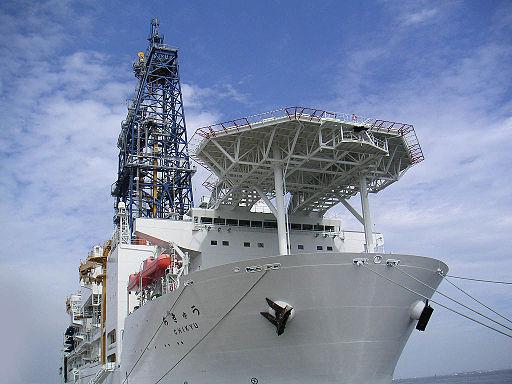
The drill bit was lowered through around 6,900 metres of water and penetrated up to 850 metres further into underlying rock – a world record for scientific drilling. Technical challenges and delays were an everyday feature of life aboard the ship, but these were offset by fascinating scientific results.
When this fault slipped, all the built up elastic strain in the crust around it was relieved (most earthquakes only relieve 10% of the accumulated strain). To do this, the fault must have been extremely frictionally weak, or slippery.
Is this unique to the Japan earthquake zone or could this happen elsewhere? Hopefully, observations of the rock cores might let us work out if other subduction zones can generate similarly large tsunamis.
Examining the Cores
Sadly, some of the most interesting core washed out of the plastic barrel designed to protect it as it was pulled back toward the surface. Nevertheless, observations, descriptions and analyses were able to be performed on the material that was recovered.
These revealed the rock has a unique mineralogy, comprising a clay mineral known as smectite in greater abundance (78%) than has been described in any other subduction fault rock before.
A distinct scaly fabric developed around the slip zone contributes to this weakness but other mechanisms probably also operate as an earthquake rupture propagates through the material.
Mechanical tests were carried out by researchers. In these, the rock cores are sheared at velocities comparable to those that would have been experienced during an earthquake (metres per second) and the frictional strength is measured.
The frictional strengths measured are among the lowest yet reported worldwide from comparable experiments. They are only 20% of the strength of normal rock.
In another novel part of the experiment, the researchers were able to independently verify two important pieces of data. There was some uncertainty based solely on rock observations that the zone of scaly rock encountered at depth was actually the fault that slipped during the 2011 earthquake. Furthermore, we wanted to confirm that the low frictional strength able to be measured in experiments was actually experienced on the fault plane during the natural event.
The key data were measurements of temperature returned from an array of thermometers lowered into the borehole during an extremely technically challenging operation.
On recovery a year or so after installation, this array had recorded a very small (less than 0.5℃) temperature fluctuation around the fault plane. This anomaly resulted from frictional shearing during the earthquake so its location confirms this was the active slip zone.
The size of the anomaly is directly proportional to the frictional strength, and careful calculations that backed out other influences on the temperature, such as the effect of fluids circulating in the borehole, yield calculated frictional strengths equal to those found in the experiments.
The Pacific Rim
The Japan Trench drilling project was a resounding success. It was clearly demonstrated that the huge tsunami was able to occur due to very low frictional strength of the fault zone, and the geological properties of the fault rock were able to be documented.
Now, the search is on to see if other subduction zones around the world are capable of generating such unexpectedly large events.
Proposed IODP scientific drilling projects in future aim to sample the Sumatran subduction zone (responsible for the 2004 Boxing Day tsunami), in mid 2016 and the Hikurangi subduction zone off northeastern New Zealand in 2018.
If similar scaly smectite-rich clays are observed in these locations to those found in Japan, we may need to dramatically revise our models of tsunami hazard around the Pacific rim.
The Hikurangi subduction system is a unique target for future investigations via scientific drilling for other reasons. There is already evidence from deposits on land that the part of this subduction zone that lies off the Wairarapa Coast of New Zealand can slip in earthquakes, cause large and sudden ground displacements, and generate tsunamis.
But some sections of the subduction zone fault slip at a much different rate – generating so-called slow-slip or silent earthquakes where the displacements takes place over days or months rather than in seconds.
During the drilling proposed for 2018 and beyond, a particular aim will be to sample faults that generate these two different styles of quake. Tests and observations like those carried out on the Japan Trench samples will provide the first link between the rocks that accommodate these events, and their slip behaviour.
Virginia Toy, Lecturer in Geology, University of Otago
This article was originally published on The Conversation. Read the original article.
