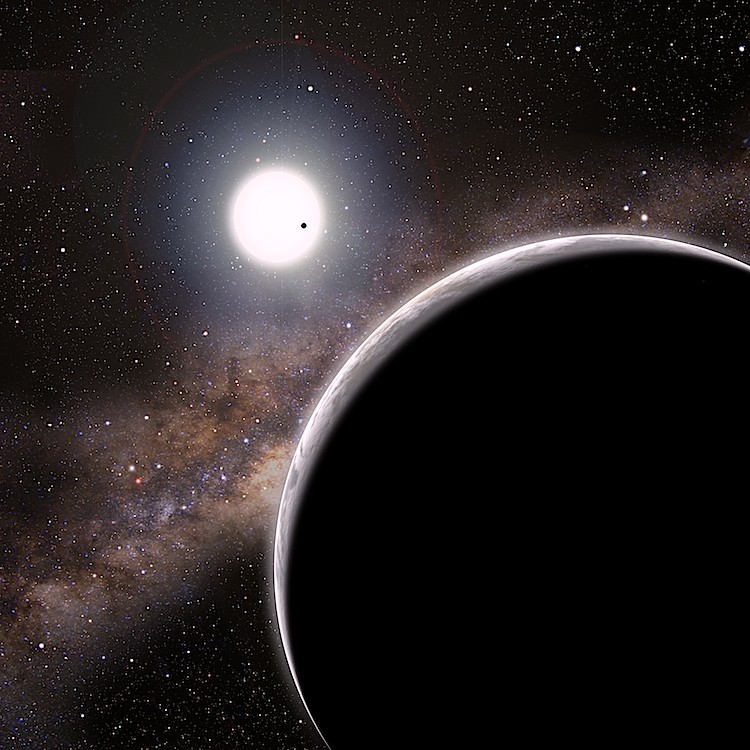
NASA’s Kepler spacecraft has pinpointed two new worlds circling the sun-like star, Kepler-19, 650 light-years away in the constellation of Lyra. However, one of them cannot actually be seen, but Kepler detected its gravitational pull on the other planet.
“This invisible planet makes itself known by its influence on the planet we can see,” said lead author Sarah Ballard, of the Harvard-Smithsonian Center for Astrophysics (CfA), in a press release.
“It’s like having someone play a prank on you by ringing your doorbell and running away. You know someone was there, even if you don’t see them when you get outside.”
The stealth planet is not the first to be detected using this technique. Back in 1846, Neptune was discovered via a similar process, because Uranus’ orbit varied from predictions, leading astronomers to predict the position of an influential world.
“This method holds great promise for finding planets that can’t be found otherwise,” said co-author David Charbonneau, also at Cfa, in the release.
Kepler can find planets because they slightly reduce a star’s light when transiting in front. Transits also provide information on the planets’ size—the bigger the drop in light, the larger a planet’s diameter compared with its star.
Kepler-19b, the visible planet, is more than twice the size of Earth, and is 8.4 million miles from its sun-like star, Kepler-19, which heats the planet to around 900 degrees Fahrenheit.
It completes a orbit every 9 days and 7 hours, but its transits are either five minutes early or late due to Kepler-19c’s gravitational effects.
Nothing is yet known about Kepler-19c, the invisible planet. Its mass cannot be measured because it is insufficient to pull on its star. Its orbit could be tilted relative to Kepler-19b, because Kepler cannot detect the unseen planet transiting its star.
“Kepler-19c has multiple personalities consistent with our data,” said co-author Daniel Fabrycky at the University of California, Santa Cruz (UCSC) in the release.
“For instance, it could be a rocky planet on a circular 5-day orbit, or a gas-giant planet on an oblong 100-day orbit.”
The paper has been accepted for publication in The Astrophysical Journal.