


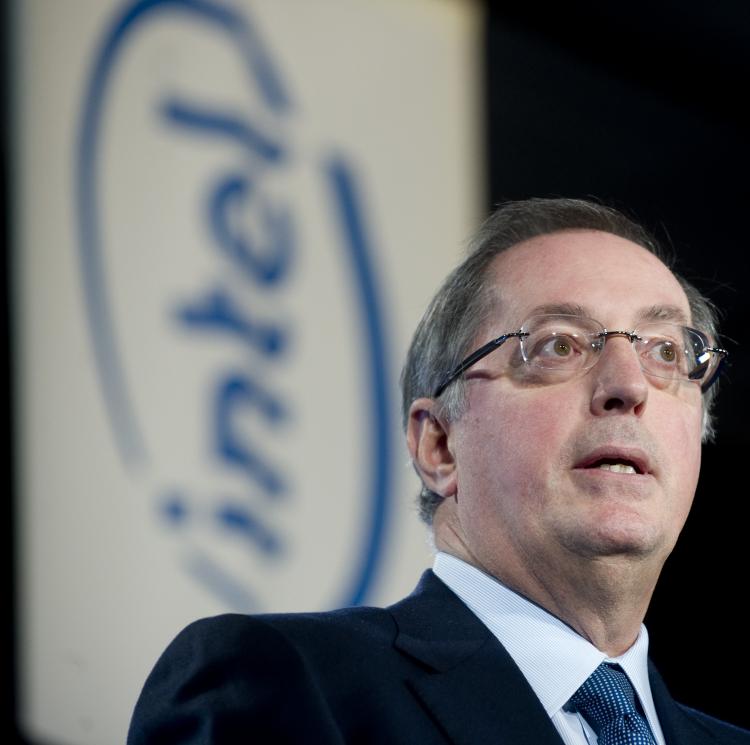
Chipmaker Intel Corporation announces plans to build a $5 billion plant in Arizona that would also hire 4,000 new employees in the United States, the company said on Feb. 18.
Preparing for a global expansion, Intel needed to expand its manufacturing capacity in the United States, the microprocessor chip company said. The state-of-the-art factory will begin operations in 2013.
Intel’s CEO, Paul Otellini, announced the deal during a visit by President Barack Obama to Intel’s factory in Hillsboro, Ore., last week.
Otellini called the new Arizona facility “Feb 42” in the announcement. “Fab 42 will be the most advanced high-volume semiconductor factory in the world,” Otellini said at the event in Oregon.
The new plant will spur rounds of hiring by Intel. “I’m proud to announce that this year Intel will hire 4,000 new permanent, highly skilled employees in the U.S.,” Otellini said. “This activity will create thousands of construction and permanent manufacturing jobs in this country.”
“This Fab will begin operations on a process that will allow us to create transistors with a minimum feature size of 14 nanometers,” said Senior Vice President of manufacturing and supply chain Brian Krzanich. “For Intel, manufacturing serves as the underpinning for our business and allows us to provide customers and consumers with leading-edge products in high volume.”
The company announced its next-generation processor chip—codenamed Sandy Bridge—last month. The company estimated that this year, a good portion of Intel’s revenues will come from sales of the new processor.
Earlier this month, Intel stopped shipment of early Sandy Bridge-based PCs and laptops as it found a design flaw in the “6 series” Sandy Bridge chips. Computers using such chips, specifically the Core i5 and i7 quad-core chips, began shipping on Jan. 9. Intel said that while the microprocessor itself is not defective—the flaw targets the serial-ATA ports within the chip, which could degrade over time—the flaw has been fixed.
Sandy Bridge-based chips are the first to integrate CPU and graphics processors on one chip, improving performance of the computer.
Intel is notable for being a United States-based company, which houses the majority of its production personnel domestically, while exporting its chips abroad.
Preparing for a global expansion, Intel needed to expand its manufacturing capacity in the United States, the microprocessor chip company said. The state-of-the-art factory will begin operations in 2013.
Intel’s CEO, Paul Otellini, announced the deal during a visit by President Barack Obama to Intel’s factory in Hillsboro, Ore., last week.
Otellini called the new Arizona facility “Feb 42” in the announcement. “Fab 42 will be the most advanced high-volume semiconductor factory in the world,” Otellini said at the event in Oregon.
The new plant will spur rounds of hiring by Intel. “I’m proud to announce that this year Intel will hire 4,000 new permanent, highly skilled employees in the U.S.,” Otellini said. “This activity will create thousands of construction and permanent manufacturing jobs in this country.”
“This Fab will begin operations on a process that will allow us to create transistors with a minimum feature size of 14 nanometers,” said Senior Vice President of manufacturing and supply chain Brian Krzanich. “For Intel, manufacturing serves as the underpinning for our business and allows us to provide customers and consumers with leading-edge products in high volume.”
The company announced its next-generation processor chip—codenamed Sandy Bridge—last month. The company estimated that this year, a good portion of Intel’s revenues will come from sales of the new processor.
Earlier this month, Intel stopped shipment of early Sandy Bridge-based PCs and laptops as it found a design flaw in the “6 series” Sandy Bridge chips. Computers using such chips, specifically the Core i5 and i7 quad-core chips, began shipping on Jan. 9. Intel said that while the microprocessor itself is not defective—the flaw targets the serial-ATA ports within the chip, which could degrade over time—the flaw has been fixed.
Sandy Bridge-based chips are the first to integrate CPU and graphics processors on one chip, improving performance of the computer.
Intel is notable for being a United States-based company, which houses the majority of its production personnel domestically, while exporting its chips abroad.


