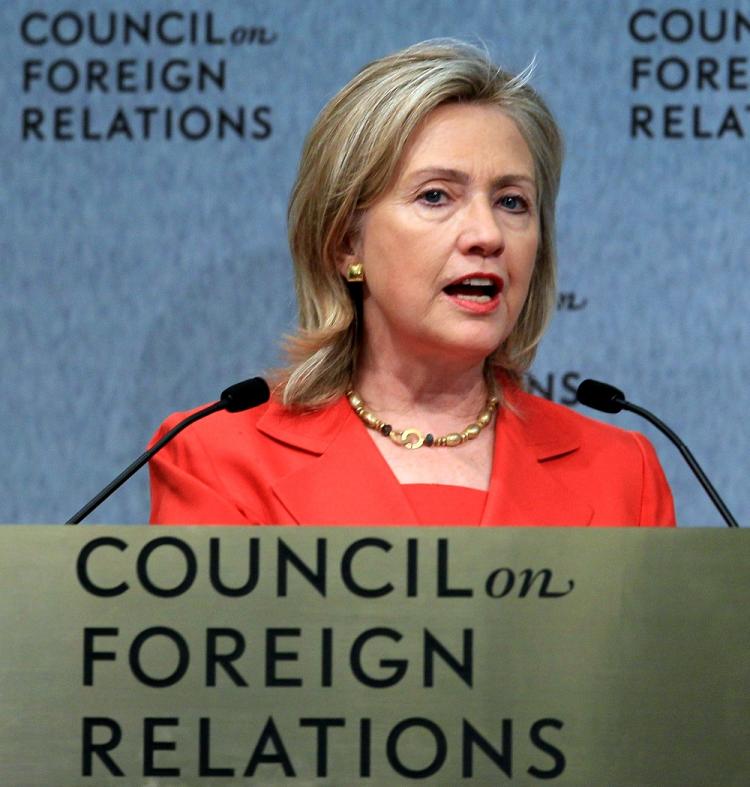
NEW YORK—U.S. leadership in the Middle East has helped foster conditions for productive negotiations between Israel and the Palestinian Authority, said Secretary of State Hilary Clinton in a speech in front of the council on foreign relations Wednesday. Clinton explained the main facets of American foreign policy in the Middle East and in other parts of the world.
“We are working to support direct talks between the Israelis and the Palestinians,” said Clinton, according to a transcript on CFR’s website. “Next week I will travel to Egypt and Jerusalem for the second round of these negotiations.”
Many U.S. officials have referred many times to the Middle East peace talks as an “American interest.” Indeed so. America’s role is not just one of mediator in negotiations between the two sides, as is sometimes portrayed, but it is also an actor with goals of its own.
“Look at the work to build institutions and spur economic development in the Palestinian territories,” said Clinton. “The United States invests hundreds of millions of dollars to build Palestinian capacity because we know that progress on the ground improves security, and helps lay the foundation for a future Palestinian state, and it creates more favorable conditions for negotiations.”
In recent years, the United States has helped to train and establish PA security forces, with cooperation from the Jordanians. These actions help abate Israeli concerns that the PA will not be able to maintain security in any future peace agreement.
“The confidence that the new Palestinian security force has displayed has affected the calculus of Israeli leadership,” said Clinton, adding that “the principal responsibility rests on the decisions made by the Palestinian Authority themselves. So with our help and their courage and commitment, we see progress that influences negotiation, and holds out a greater promise for an eventual agreement.”
During the past year, Palestinian Prime Minister Salam Fayyad has implemented a plan to increase Palestinian capacity building, so as to unilaterally achieve statehood within two years. This program emphasizes building strong government agencies, and economic development, and is supported by major international bodies such as the World Bank. The United States and Europe have also greatly cooperated with this plan.
“It is time for our people to obtain their unconditional freedom and national rights as required by international law. ... For our part, we have to dedicate ourselves to the task of state-building. This will be critical to our success,” reads the official document of Fayyad’s plan.
Fayyad’s plan was somewhat of an alternative to the negotiations, even though the two are not mutually exclusive. Israel objected to the plan in the past, due to its unilateralism. Since Israel’s Prime Minister Benjamin Netanyahu ascended to the throne, he has emphasized “economic peace,” as part of his policy toward the Palestinians. In several speeches he claimed credit for positive economic development in the PA, mentioning Israeli actions to foster those developments.
The first round of direct talks between Israel and the Palestinians started n Washington last week. This round of talks is the product of a few months of proximity talks mediated by U.S. Special Envoy George Mitchell.
During the 20-year long Israeli-Palestinian peace process, many of the outstanding issues have been discussed. Nevertheless the peace process—“The Annapolis process,” under President George W. Bush—was put on hold after the last elections in Israel two years ago.
Restarting the talks was not an easy task for the Obama administration as the two sides refused to give ground on certain key issues. The Palestinians, on their part, refused to go into direct negotiations without a predetermined time frame for them, a complete halt of all Israeli settlement activity in the West Bank and East Jerusalem, and a guarantee that negotiations will be based on the 1967 borders.
Netanyahu claimed during this time that he was willing to start direct talk at any time, but only “without any preconditions.” Nonetheless, he demanded Palestinian recognition of Israel as the nation-state of the Jewish people. He also demanded retaining Israeli security mechanisms “on the ground” to make sure that area’s Israel withdrawals from, will not turn into launch pads of terrorism.
In the end, under pressure from the United States, the two sides agreed to direct talks.
In her speech, Clinton explained how interwoven are the phalanges facing U.S. foreign policy. “Consider the Middle East peace talks. At one level they are bilateral negotiations involving two peoples and a relatively small strip of land. But step back and it becomes clear how important the regional dimensions and even the global dimensions of what started last week are,” said Clinton.
“We are working to support direct talks between the Israelis and the Palestinians,” said Clinton, according to a transcript on CFR’s website. “Next week I will travel to Egypt and Jerusalem for the second round of these negotiations.”
Many U.S. officials have referred many times to the Middle East peace talks as an “American interest.” Indeed so. America’s role is not just one of mediator in negotiations between the two sides, as is sometimes portrayed, but it is also an actor with goals of its own.
“Look at the work to build institutions and spur economic development in the Palestinian territories,” said Clinton. “The United States invests hundreds of millions of dollars to build Palestinian capacity because we know that progress on the ground improves security, and helps lay the foundation for a future Palestinian state, and it creates more favorable conditions for negotiations.”
In recent years, the United States has helped to train and establish PA security forces, with cooperation from the Jordanians. These actions help abate Israeli concerns that the PA will not be able to maintain security in any future peace agreement.
“The confidence that the new Palestinian security force has displayed has affected the calculus of Israeli leadership,” said Clinton, adding that “the principal responsibility rests on the decisions made by the Palestinian Authority themselves. So with our help and their courage and commitment, we see progress that influences negotiation, and holds out a greater promise for an eventual agreement.”
During the past year, Palestinian Prime Minister Salam Fayyad has implemented a plan to increase Palestinian capacity building, so as to unilaterally achieve statehood within two years. This program emphasizes building strong government agencies, and economic development, and is supported by major international bodies such as the World Bank. The United States and Europe have also greatly cooperated with this plan.
“It is time for our people to obtain their unconditional freedom and national rights as required by international law. ... For our part, we have to dedicate ourselves to the task of state-building. This will be critical to our success,” reads the official document of Fayyad’s plan.
Fayyad’s plan was somewhat of an alternative to the negotiations, even though the two are not mutually exclusive. Israel objected to the plan in the past, due to its unilateralism. Since Israel’s Prime Minister Benjamin Netanyahu ascended to the throne, he has emphasized “economic peace,” as part of his policy toward the Palestinians. In several speeches he claimed credit for positive economic development in the PA, mentioning Israeli actions to foster those developments.
The first round of direct talks between Israel and the Palestinians started n Washington last week. This round of talks is the product of a few months of proximity talks mediated by U.S. Special Envoy George Mitchell.
During the 20-year long Israeli-Palestinian peace process, many of the outstanding issues have been discussed. Nevertheless the peace process—“The Annapolis process,” under President George W. Bush—was put on hold after the last elections in Israel two years ago.
Restarting the talks was not an easy task for the Obama administration as the two sides refused to give ground on certain key issues. The Palestinians, on their part, refused to go into direct negotiations without a predetermined time frame for them, a complete halt of all Israeli settlement activity in the West Bank and East Jerusalem, and a guarantee that negotiations will be based on the 1967 borders.
Netanyahu claimed during this time that he was willing to start direct talk at any time, but only “without any preconditions.” Nonetheless, he demanded Palestinian recognition of Israel as the nation-state of the Jewish people. He also demanded retaining Israeli security mechanisms “on the ground” to make sure that area’s Israel withdrawals from, will not turn into launch pads of terrorism.
In the end, under pressure from the United States, the two sides agreed to direct talks.
In her speech, Clinton explained how interwoven are the phalanges facing U.S. foreign policy. “Consider the Middle East peace talks. At one level they are bilateral negotiations involving two peoples and a relatively small strip of land. But step back and it becomes clear how important the regional dimensions and even the global dimensions of what started last week are,” said Clinton.