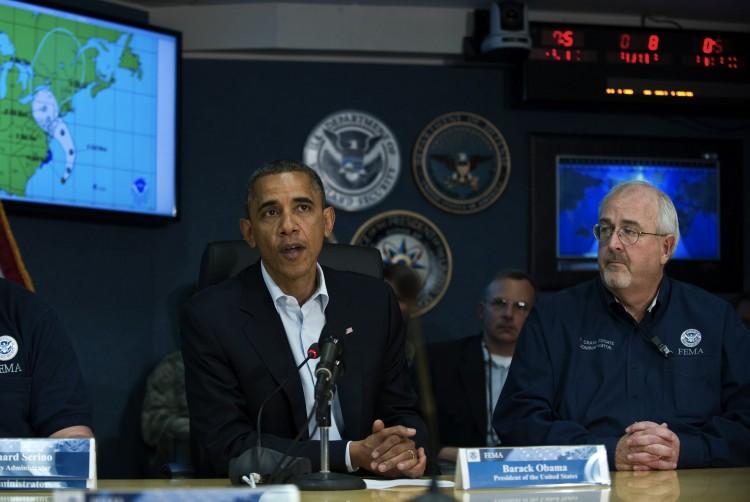
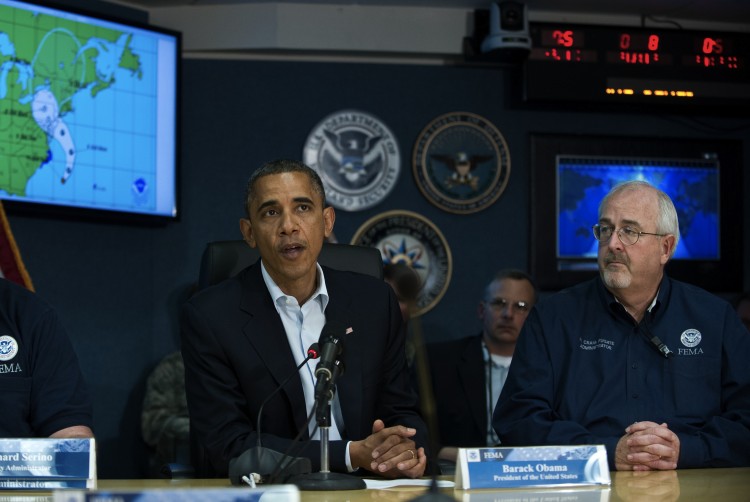
As Hurricane Sandy approached its predicted Oct. 29 landfall, “the entire federal family,” businesses, and non-profits worked together to handle the storm, according to Federal Emergency Management Agency (FEMA) administrator Craig Fugate.
FEMA is bringing supplies including water, food, generators, and cots to multiple staging areas in different states, said Fugate at a telephone press conference. The agency is delivering giant generators to states—the kind that can power hospitals or water treatment plants, according to Fugate. FEMA is also consulting with the Army Corps of Engineers to see what the states will need.
By 2:30 p.m. on Oct. 29, seven states and the District of Columbia had federal emergency declarations. That means FEMA can already start giving commodities to the states and D.C. The agency will give money later on.
The Disaster Response Fund has $3.6 billion on hand, according to Fugate.
“As Sandy keeps moving closer to the coast, we are rapidly moving from preparation to response,” he said.
It is hard to predict exactly when and where the storm will come ashore, “when a storm is tilted and sheared and beginning to lose its tropical characteristics,” said NOAA’s National Hurricane Center (NHC) director Dr. Rick Knabb, also on the conference call.
This storm is unusual because a hurricane has merged with a winter storm in a way that makes the hurricane much larger and more diffuse, while it still has hurricane-force winds up to 90 miles per hour. Because of those factors, it is not too relevant to focus on landfall, according to Knabb.
The full moon is not that important, either, he said. It may only add about one foot to the high tide and storm surge, expected Oct. 30. Rainfall, however, is very important; in some places, rainfall could exceed one foot, contributing to floods and flash floods. In the Appalachian Mountains, Virginia, and West Virginia, the storm “also has a snow component,” said Knabb.