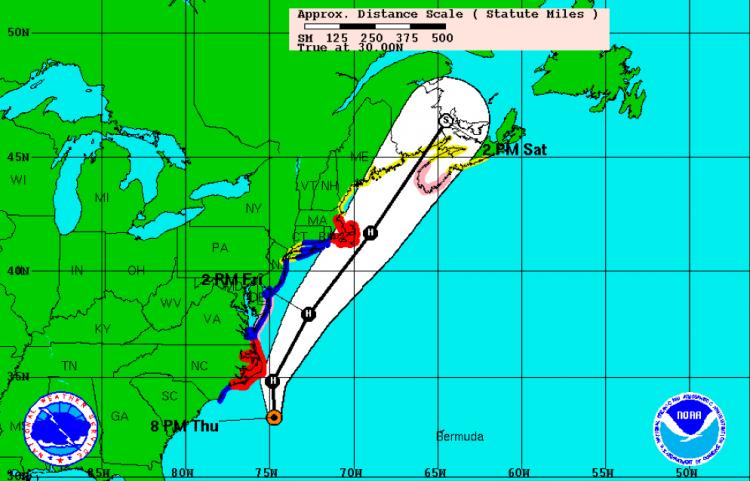
Winds reaching 110 mph from Hurricane Earl are expected to reach North Carolina’s Outer Banks Thursday night even if the center of Earl remains offshore, according to the National Hurricane Center.
On its forecasted track, the center of the hurricane will approach southeast New England Friday evening before traveling farther north to the Canadian maritime provinces.
“Millions of people will be affected by this massive storm,” the Weather Channel warned on its website.
Situated 160 miles away from Cape Hatteras on Thursday evening, Earl, a Category 2 storm, is heading toward North Carolina at 18 mph.
The hurricane is expected to bring raised water levels, heavy rainfall, gusty winds, dangerous surf, and large swells to the East Coast. Data collected by a reconnaissance plane indicates that Earl will increase in speed, but decrease in intensity in the next few days.
A Category 2 storm on the Saffir-Simpson Hurricane Scale carries along “extremely dangerous winds” and can cause “extensive damage,” according to the center.
Early Thursday morning, U.S. officials issued a mandatory evacuation for 30,000 residents and visitors on Hatteras Island and 5,000 people on Ocracoke Island, which is only accessible by ferry and airplane.
“The majority of the people have evacuated from Ocracoke,” said officials from the Hyde County on Thursday, which is located 25 miles away from Ocracoke Island. “Right now, most people feel all they can do is wait and see which direction Earl goes. Everyone is hoping for the best.”
Lucy Wallace, a public information officer for the North Carolina ferry division, said that by midafternoon on Thursday, it was too dangerous for the ferries to take any more people from Ocracoke Island to the mainland.
“The ferry stopped taking people from Ocracoke, as those who should have evacuated should have done so already,” she said. “It’s become too windy and needed to stop ferry evacuations.”
On Thursday morning, President Barack Obama declared an emergency in North Carolina and the North Carolina National Guard is deploying 80 troops to assist in the situation. Obama authorized the Department of Homeland Security and Federal Emergency Management Agency to coordinate all disaster relief efforts.
With additional reporting by Kelly Ni.
On its forecasted track, the center of the hurricane will approach southeast New England Friday evening before traveling farther north to the Canadian maritime provinces.
“Millions of people will be affected by this massive storm,” the Weather Channel warned on its website.
Situated 160 miles away from Cape Hatteras on Thursday evening, Earl, a Category 2 storm, is heading toward North Carolina at 18 mph.
The hurricane is expected to bring raised water levels, heavy rainfall, gusty winds, dangerous surf, and large swells to the East Coast. Data collected by a reconnaissance plane indicates that Earl will increase in speed, but decrease in intensity in the next few days.
A Category 2 storm on the Saffir-Simpson Hurricane Scale carries along “extremely dangerous winds” and can cause “extensive damage,” according to the center.
Early Thursday morning, U.S. officials issued a mandatory evacuation for 30,000 residents and visitors on Hatteras Island and 5,000 people on Ocracoke Island, which is only accessible by ferry and airplane.
“The majority of the people have evacuated from Ocracoke,” said officials from the Hyde County on Thursday, which is located 25 miles away from Ocracoke Island. “Right now, most people feel all they can do is wait and see which direction Earl goes. Everyone is hoping for the best.”
Lucy Wallace, a public information officer for the North Carolina ferry division, said that by midafternoon on Thursday, it was too dangerous for the ferries to take any more people from Ocracoke Island to the mainland.
“The ferry stopped taking people from Ocracoke, as those who should have evacuated should have done so already,” she said. “It’s become too windy and needed to stop ferry evacuations.”
On Thursday morning, President Barack Obama declared an emergency in North Carolina and the North Carolina National Guard is deploying 80 troops to assist in the situation. Obama authorized the Department of Homeland Security and Federal Emergency Management Agency to coordinate all disaster relief efforts.
With additional reporting by Kelly Ni.