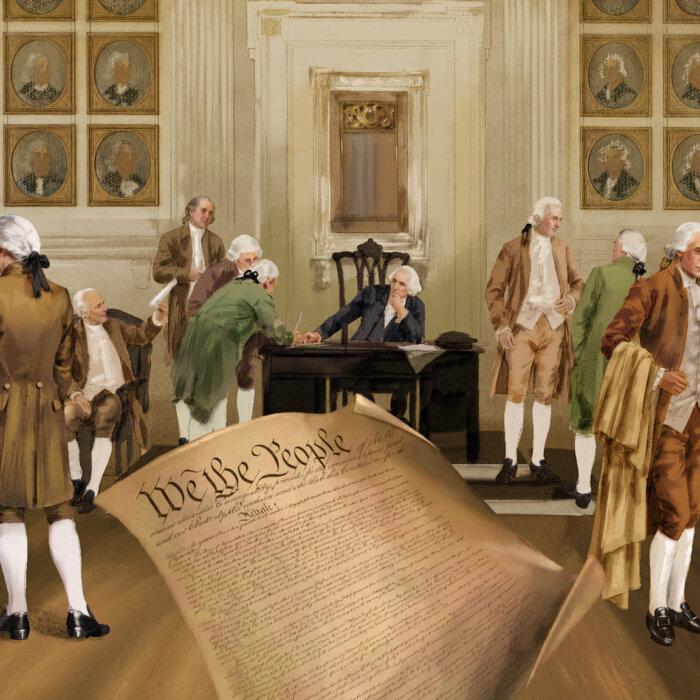
Under a veil of secrecy, the framers of the U.S. Constitution met behind locked doors and closed windows during the steamy Philadelphia summer of 1787.
So important was their work that dirt was spread across the cobblestone street to muffle the clatter of passing carriages in front of the Pennsylvania State House, where guards were posted. Inside, 55 delegates gathered to hammer out the framework of the fledgling nation’s government.
The group included Founding Fathers such as George Washington, James Madison, Benjamin Franklin, and Alexander Hamilton—titans of their age who forged the Constitution into one of the most enduring and consequential documents in history.
The U.S. Constitution is considered the world’s longest-surviving written charter of government.
In the modern era, America’s constitutional republic is often compared to the Roman Republic, which lasted nearly 500 years, because of their similar size and power in their respective eras.
The framers of the Constitution were attempting a momentous feat, an experiment in self-governance on a grand scale. For more than two millennia, kings and queens had ruled nations almost exclusively.
Caroline Winterer, chair of Stanford University’s history department, during a 2020 interview, explained what the framers were trying to accomplish was nothing short of extraordinary.
“It required them to completely overturn 2,000 years of thinking about political science,” she said.
Only a few small countries existing today can claim to have republics older than that of the United States. Examples include San Marino, a European microstate that claims to be the world’s oldest republic, founded in A.D. 301, and Switzerland, which has a decentralized self-governance dating back to its Federal Charter of 1291.
“I think we are the longest-lasting stable democracy in the history of humankind, and that’s because of the Constitution,” said Hans von Spakovsky, senior legal fellow at Advancing American Freedom.
In the late 19th century, British Prime Minister William Gladstone observed that America’s Constitution, created in a matter of months, was one of the greatest documents ever written.
“The American Constitution is the most wonderful work ever struck off at a given time by the brain and purpose of man,” Gladstone said.
The framers incorporated the best of ancient Western political philosophy, such as the separation of powers, checks and balances, and republicanism from Rome and Greece into the Constitution.
They studied Roman history, drawing on writers such as Polybius, Cicero, and Livy, and viewed the ancient Roman Republic as a successful model of republican government before it ultimately fell to tyranny.
Von Spakovsky said the framers of the Constitution were highly educated and familiar with the history of Rome and Greece. When they wrote the Constitution, they also took into account the successes and failures of these ancient Western civilizations.
“They took the best of those features and then put in provisions to try to fix the problems,” von Spakovsky said.
In the 2025 book “The Golden Thread: A History of the Western Tradition,” historian James Hankins documents Rome’s shift from a monarchy to a republic. In 509 B.C., the Romans decided to replace their single king with two rulers, or consuls. The idea was to curb the monarchy’s power by dividing it between two consuls and limiting their terms to one year.
Liberty to the Romans meant “refusal to place permanent, unrestricted political power in the hands of a single individual,” according to the book.
Madison, considered the Father of the Constitution, was familiar with Greek democracies through the writings of Aristotle, Plato, and Plutarch. Like Aristotle, he viewed pure direct democracy, in which citizens voted on laws, as unstable and vulnerable to mob rule.
Brenda Hafera, assistant director of The Heritage Foundation’s B. Kenneth Simon Center for American Studies, said that historically, republics were small, which allowed the public to be heard. But small nations were more susceptible to being conquered and to factions that could rip a nation apart.
That’s when Madison stepped in with a solution, she said. Madison argued that a large, diverse republic was the best way to combat the dangers posed by factions, groups that look out for their own self-interest rather than the common good.
These factions would likely cancel each other out, making it less likely that any one group could gain a majority. Instead, they would have to persuade others to support their cause, she noted.
—Darlene Sanchez McCormick
BOOKMARKS
U.S. President Donald Trump will travel to Ankara, Turkey, to attend the NATO summit on July 7 and 8, where leaders are expected to review progress on the alliance’s defense spending commitments and burden-sharing goals. The Epoch Times’ Emel Akan reported that Trump is expected to meet with Ukrainian President Volodymyr Zelenskyy and Syrian President Ahmed al-Sharaa on the sidelines of the summit.
The Bureau of Alcohol, Tobacco, Firearms, and Explosives (ATF) has indicated it will further roll back laws and rules on guns, The Epoch Times’ Jack Phillips reported, with the agency proposing to reduce fingerprinting requirements on applications for certain types of firearms. Since April, the ATF has moved to end a number of federal firearms rules.
Jailed Christian leader Ezra Jin, also known as Jin Mingri, has been released from custody in China, The Epoch Times’ Ryan Morgan reported. Jin is the founder and pastor of Zion Church, an underground Christian church operating in China. Chinese authorities detained Jin and several other pastors and congregants in October 2025 in what human rights groups described as an escalating campaign against religious freedom.
A new bill in Congress would enshrine into law the ability of the executive branch to buy into private companies, and create a fund to finance the purchases, The Epoch Times’ Kevin Stocklin reported. While administration officials say this move allows the War Department to better align its goals with the private sector and for taxpayers to earn a return if the companies do well, critics have raised concerns about establishing a legal basis for government expansion into the private sector.