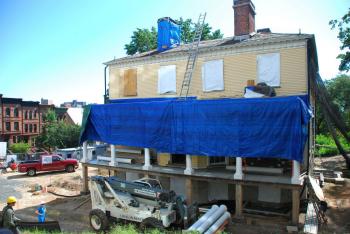
NEW YORK—Hamilton Grange, Alexander Hamilton’s house in Harlem was the only home ever owned by Founding Father Alexander Hamilton (1755 or 1757-1804)—the only New Yorker who signed the Constitution of the United States.
The Federal-style country house was a masterpiece by architect John McComb Jr., who also designed New York City Hall. Lying on Hamilton’s 32-acre estate, the Grange was named after Hamilton’s grandfather’s estate in Scotland. However, this beautiful home has faced countless ordeals since Hamilton was killed only two years after it was complete.
“His dining room faced New Jersey and the East River. It was a beautiful piece of land,” said Edward Mucci, a park ranger with the National Park Service (NPS). “Unfortunately in New York City we are always developing, we are always changing. … In 1889, they were putting the grid system [of streets] in, and this building didn’t quite fit that grid. So they were going to get rid of it.”
“The man who owned the property wanted to make the maximum amount of money and run all the streets he could—only the house was in his way. So he was going to sell it for scrap. Instead of selling it for scrap, the church, which booked property at the end of the road but had no building said, ‘If you want to move the building to our property, you can do that.’”
The Grange was saved but it moved 350 feet southeast and was squeezed into a lot at 287 Convent Avenue of St. Luke’s Episcopal Church’s property. The house’s basement and two porches had to be removed; front and back entrances were shifted to the two sides of the house; and the staircase was removed and retrofitted to suit the new entrance.
The Federal-style country house was a masterpiece by architect John McComb Jr., who also designed New York City Hall. Lying on Hamilton’s 32-acre estate, the Grange was named after Hamilton’s grandfather’s estate in Scotland. However, this beautiful home has faced countless ordeals since Hamilton was killed only two years after it was complete.
“His dining room faced New Jersey and the East River. It was a beautiful piece of land,” said Edward Mucci, a park ranger with the National Park Service (NPS). “Unfortunately in New York City we are always developing, we are always changing. … In 1889, they were putting the grid system [of streets] in, and this building didn’t quite fit that grid. So they were going to get rid of it.”
“The man who owned the property wanted to make the maximum amount of money and run all the streets he could—only the house was in his way. So he was going to sell it for scrap. Instead of selling it for scrap, the church, which booked property at the end of the road but had no building said, ‘If you want to move the building to our property, you can do that.’”
The Grange was saved but it moved 350 feet southeast and was squeezed into a lot at 287 Convent Avenue of St. Luke’s Episcopal Church’s property. The house’s basement and two porches had to be removed; front and back entrances were shifted to the two sides of the house; and the staircase was removed and retrofitted to suit the new entrance.