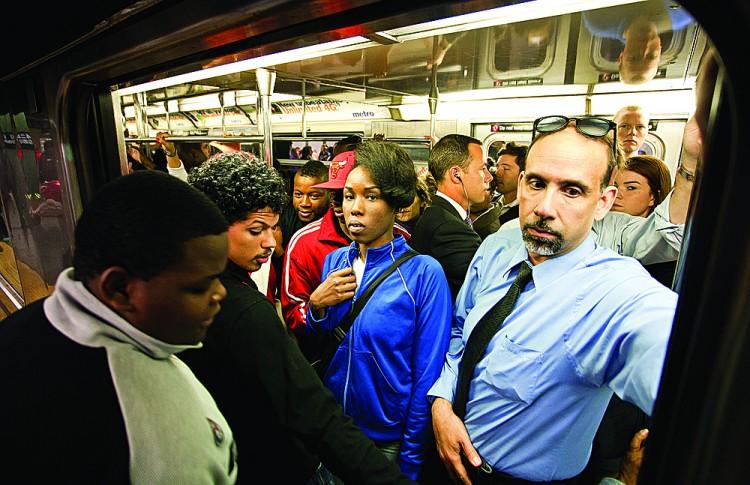
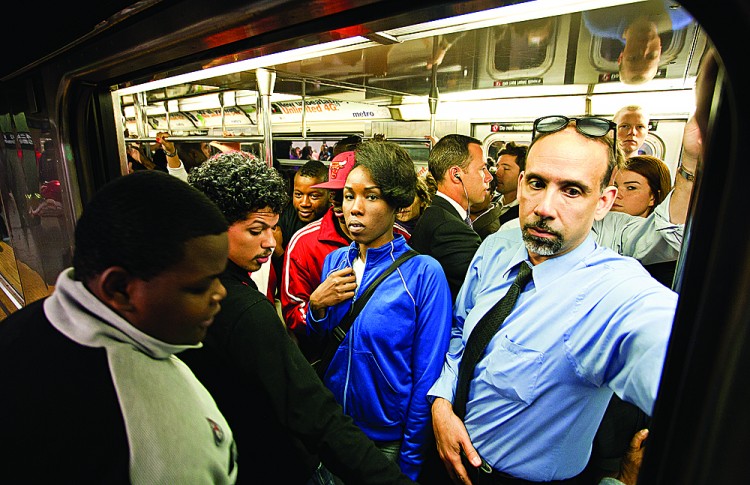
NEW YORK—Increasingly high ridership on the city’s subways has caused overcrowding at stations and trains, particularly on the Lexington Avenue Nos 4, 5, and 6 lines.
Numbers released Monday show average weekday ridership in July—5.2 million—was an increase of 2 percent from July 2011, and the highest average in any July in 45 years.
Reflecting the ridership increase, fare box revenues in July climbed 1.3 percent to $315 million.
But the good news, that public transit continues its trend of increasing popularity, is tempered by crowding, and has led to contemplation by transit analysts and officials from the Metropolitan Transportation Authority (MTA), which runs the subway and bus systems, about how to deal with it.
Not Stepping Aside
People standing in front of subway doors and not letting people off is one problem that causes delays.
“Cumulatively it’s a big issue,” said William Henderson, executive director of the MTA’s Permanent Citizen’s Advisory Committee. “If you have it happening thousands of times, it slows the trains up ... you can’t close the doors as quickly, and they just slow up the whole line.”
Overcrowding caused 3,999 delayed trains during weekdays in July, out of 24,999 total. A delayed train is defined as one that arrives at a destination terminal more than five minutes late or skips planned stations.
Almost half of respondents to a MTA survey said subway trains are too crowded during rush hours.
Two solutions put forth by the MTA are encouraging riders to stand out of the way through a periodic publicity campaign, and having platform conductors help underground traffic run smoothly at the busiest stations, such as Grand Central Terminal.
Capital Projects May Help
The MTA’s four megaprojects, all in Manhattan, may help ease overcrowding, especially the Second Avenue subway (SAS) on the Upper East Side.
The new subway line is slated for opening in December 2016. SAS will run in its first phase from 96th Street, four avenues east of the Nos 4, 5, and 6 lines, before turning west into the Lexington Avenue/63rd Street station.
On the first day the new line opens, the MTA estimates it will have 300,000 riders, according to Gene Russianoff, staff attorney with the New York Public Interest Research Group’s Straphangers Campaign. SAS will draw some people from the Nos 4, 5, and 6, but a number of riders who will need to travel further south won’t use SAS right away. Full build out for the new line is from 125th Street to Hanover Square, but the other three phases do not have funding or construction schedules in place.
Another capital project, extending the No. 7 line southwest from Times Square, is slated for completion in June 2014.
But that likely won’t help ease overcrowding, since it isn’t near other subway lines, said Henderson. Bus rapid transit, also known as select bus service, and which works faster than traditional buses, is a much less expensive alternative to building new subway lines and stations for added capacity.
One plan in the works is running supplemental bus service on the far West Side that could take some pressure off the Nos 1, 2, and 3 lines, said Henderson.
Russianoff said another easement option is modernizing train signals, which on most lines are from the 19th century and act like traffic lights. The cross-city L line has modern signals, which enables more trains to run, but it came from several years of work and hundreds of millions of dollars.
I. T. professional James Morris, just before hopping onto a crowded No. 4 train Monday afternoon from Grand Central, said “more trains” is what he thinks could ease overcrowding.
A more unconventional option—replacing seats on the No. 4 and no. 5 lines with pop-up seats, like they have in Tokyo, which would let cars hold more people—was “seriously entertained” by the last president of the transit authority, said Russianoff. But the proposal was later ditched.
“We hated the idea,” Russianoff said, “because if you have to go all the way from Flatbush to northern Bronx, you'd have to stand the whole way.”
The Epoch Times publishes in 35 countries and in 19 languages. Subscribe to our e-newsletter.