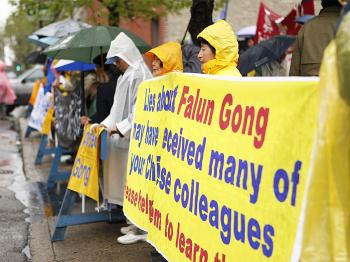
CHICAGO—Adherents of the spiritual practice Falun Gong have at great risk to themselves carried on an unprecedented civil disobedience campaign in China for 11 years. On Sunday, Falun Gong practitioners gathered for a rally in a steady rain opposite the Chinese Consulate in Chicago to mark the eleventh anniversary of the first such act of civil disobedience, staged by tens of thousands of practitioners in Beijing on April 25, 1999. Three veterans of that day spoke and gave a glimpse into why Falun Gong practitioners acted as they did 11 years ago and continue doing so today.
“At that time at a superficial level we practitioners went to appeal for Falun Gong, but in actuality we were giving the Chinese regime an opportunity to make a choice. We gave them an opportunity, and let them choose right or wrong. It is a huge event in Chinese history,” said Ms. Cui Zijing, one of the participants in the April 25 appeal who spoke at the rally.
The event in 1999 had been triggered by the arrest of 45 practitioners in Tianjin, a city 70 miles southeast of Beijing. When practitioners in Tianjin went to the municipal authorities there and asked for the release of those arrested, they were told that the Tianjin authorities had received orders from above. The practitioners needed to take their case to the central authorities.
According to Mr. Yang Qing, who also took part in the April 25 appeal and spoke at the Chicago rally, the practitioners in Tianjin spread the news of what the municipal authorities had said. Falun Gong practitioners not only from Beijing but throughout China decided to go to the State Appeals Office—the office whose stated purpose is to allow Chinese citizens to complain of wrongdoing by the authorities and seek redress—in Beijing on April 25.
In fact, as the crowd began to grow, they were not allowed by police to go to the Appeals Office. The Appeals Office is a few hundred yards, up Fuyou Street, from Zhongnanhai. This ancient compound houses the offices and living quarters of the top leaders of the Chinese Communist Party (CCP).
Mr. Xu Yen, who also spoke at the Chicago rally, was a professor at Tsinghua University, commonly known as “China’s M.I.T.” He arrived very early that morning on Fuyou Street.
“The police at first had the street going to Zhongnanhai blocked,” Mr. Xu said. “They should have kept the streets blocked. But instead of keeping people away from Zhongnanhai they opened the streets and then began directing practitioners to the streets around Zhongnanhai. They directed them to stand so that eventually practitioners surrounded Zhongnanhai.” The Chinese regime’s propaganda would later claim that the practitioners “surrounded” and “laid siege” to Zhongnanhai.
Mr. Yang, now retired, was a mechanical engineer in China and has spent a lifetime making precise observations. He walked the road leading to the Appeals Office and calculated there were 40,000 people there on both sides of the road.
“But there were many, many more practitioners there. Changhai Street was blocked to me, but on the other side of the blockade were many practitioners.”
“At the time, the international media based in Beijing estimated that between 100,000 and 150,000 practitioners gathered. The Chinese regime’s state-controlled media, however, said there were 10,000. Ever since, the media have reported 10,000. It is not true,” Mr. Yang said.
“At that time at a superficial level we practitioners went to appeal for Falun Gong, but in actuality we were giving the Chinese regime an opportunity to make a choice. We gave them an opportunity, and let them choose right or wrong. It is a huge event in Chinese history,” said Ms. Cui Zijing, one of the participants in the April 25 appeal who spoke at the rally.
Looking for the Appeals Office
The event in 1999 had been triggered by the arrest of 45 practitioners in Tianjin, a city 70 miles southeast of Beijing. When practitioners in Tianjin went to the municipal authorities there and asked for the release of those arrested, they were told that the Tianjin authorities had received orders from above. The practitioners needed to take their case to the central authorities.
According to Mr. Yang Qing, who also took part in the April 25 appeal and spoke at the Chicago rally, the practitioners in Tianjin spread the news of what the municipal authorities had said. Falun Gong practitioners not only from Beijing but throughout China decided to go to the State Appeals Office—the office whose stated purpose is to allow Chinese citizens to complain of wrongdoing by the authorities and seek redress—in Beijing on April 25.
In fact, as the crowd began to grow, they were not allowed by police to go to the Appeals Office. The Appeals Office is a few hundred yards, up Fuyou Street, from Zhongnanhai. This ancient compound houses the offices and living quarters of the top leaders of the Chinese Communist Party (CCP).
Mr. Xu Yen, who also spoke at the Chicago rally, was a professor at Tsinghua University, commonly known as “China’s M.I.T.” He arrived very early that morning on Fuyou Street.
“The police at first had the street going to Zhongnanhai blocked,” Mr. Xu said. “They should have kept the streets blocked. But instead of keeping people away from Zhongnanhai they opened the streets and then began directing practitioners to the streets around Zhongnanhai. They directed them to stand so that eventually practitioners surrounded Zhongnanhai.” The Chinese regime’s propaganda would later claim that the practitioners “surrounded” and “laid siege” to Zhongnanhai.
Tens of Thousands Appear
Mr. Yang, now retired, was a mechanical engineer in China and has spent a lifetime making precise observations. He walked the road leading to the Appeals Office and calculated there were 40,000 people there on both sides of the road.
“But there were many, many more practitioners there. Changhai Street was blocked to me, but on the other side of the blockade were many practitioners.”
“At the time, the international media based in Beijing estimated that between 100,000 and 150,000 practitioners gathered. The Chinese regime’s state-controlled media, however, said there were 10,000. Ever since, the media have reported 10,000. It is not true,” Mr. Yang said.