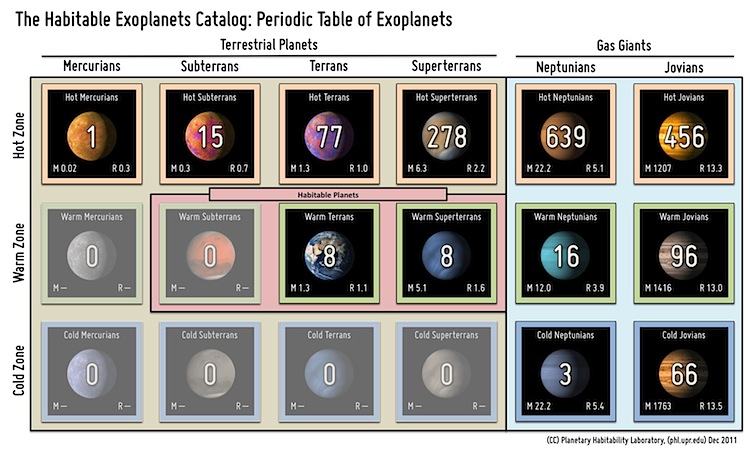
The habitability of numerous exosolar planets detected during the last two decades has been ranked in a new catalog called the Habitable Exoplanets Catalog (HEC).
More than 700 planets have been discovered orbiting stars in other solar systems, as well as various exomoons, and thousands more candidates remain to be confirmed.
Most of the planets are hot gas giants, like Jupiter, circling their suns very closely. Just a handful are the right size and orbiting their stars at a distance amenable to life, being neither too hot nor too cold.
The HEC was created by the Planetary Habitability Laboratory (PHL) at the University of Puerto Rico at Arecibo (UPR Arecibo).
“One important outcome of these rankings is the ability to compare exoplanets from best to worst candidates for life,” said Abel Méndez, Director of the PHL, in a press release.
Criteria include the Earth Similarity Index (ESI), the Habitable Zones Distance (HZD), and the Global Primary Habitability (GPH) systems. The HEC also incorporates information from other databases like NASA’s Kepler Mission.
“New observations with ground and orbital observatories will discover thousands of exoplanets in the coming years,” Méndez said.
“We expect that the analyses contained in our catalog will help to identify, organize, and compare the life potential of these discoveries.”
One of the catalog’s classifications divides planets into 18 mass and thermal categories, forming an exoplanet ‘periodic table.’
To date, only two known exoplanets–Gliese 581d and HD 85512b–meet the catalog’s habitability criteria. They both have marginal similarities to Earth.
More than 15 other exoplanets plus 30 exomoons are potentially habitable, with further observations required to confirm their status, for example using the proposed NASA Terrestrial Planet Finder (TPF).