NEW YORK—A Chinese cartoon artist who the Chinese Communist Party has charged with “slandering the Party and Party members,” escaped to New York last year.
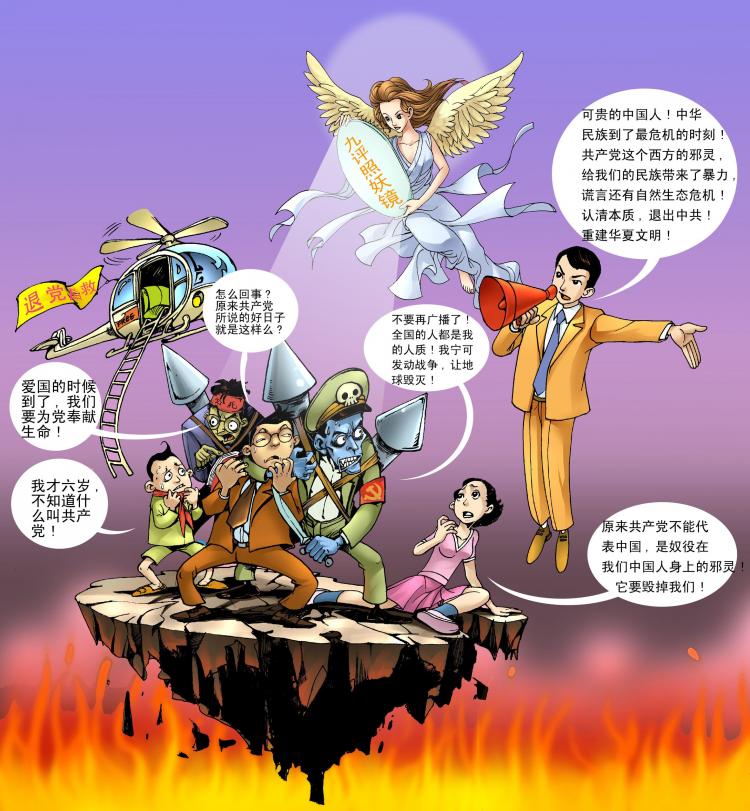
Guo Jingxiong, for those outside of China who might not know, has achieved a level of fame comparable to that of cartoonist Frank Frazetta in the Western world. In 2006, Guo was the first Chinese to win the top award in the Angoulême International Comics Festival, the equivalent of the Oscar Awards of comics. He then signed a contract with the biggest comics publishing company in Europe, where his work made the top three in the 2007 best selling comics list. Currently, his published repertoire includes one hundred comic books that were either illustrated by him or contain his work.
His artistic style is far-ranging; from intricate, sharply defined sci-fi characters to pen-and-ink drawings that take on the personality of a Chinese brush painting.
Guo’s story remains one unique to a modern China under communist rule. A Falun Gong practitioner, Guo is wanted by the State police for using his art to speak for those persecuted by the Chinese Communist Party (CCP), something that amounts to slander in the regime’s books.
Many of his political cartoons during 1999-2003 portrayed China’s then-Chairman Jiang Zemin, the initiator of the persecution of Falun Gong, as a rotund and jealous figure. In addition, he illustrated the Nine Commentaries on The Communist Party, The Epoch Times’ criticisms of the Chinese regime.
Threats from the Chinese regime aside, working as an artist offers ample challenges. “It’s hard to express individuality with the industry restrictions,” Guo said. “Often the authorities don’t let you write your own story lines because the story might touch upon the topics of freedom and social injustice—that’s why many artists turn to stories from traditional culture.”
Guo is one of those who chose traditional stories as his subject. Among his books is a cartoon adaptation of Shui Hu, or Water Margin, one of China’s four great classical novels.
His works bases on Chinese traditional culture and is founded on the principles of Chinese painting. The essence of Chinese painting is to capture the inner likeness of a being, not to caricature the being’s outer likeness as Japanese and American comics tend to do, according to Guo. The aim of Chinese visual art is to “convey the spirit, not to exaggerate the appearance,” he said.
Before the turn of the 20th century, artists in China were used to draw propaganda materials. Then, around 1991, knockoff Japanese comic books appeared on the shelves by the millions, according to Guo.
Japanese comics’ popularity was a result of young Chinese' yearning to find individuality in a society that perpetuates uniformity. “They found a realization of their dreams of freedom role models in the characters,” Guo said. “It was a departure from the dryness of Chinese textbooks.”
When the CCP realized that comics were a hot sell, they shut down the counterfeit circles and started an ambitious campaign to produce five of each type of artistic and literary every year. The project lasted until 1994 and failed to meet its goals every year, according to Guo.
That left the comics market open. “It was like crossing a river by grabbing hold of rocks,” Guo said. “There was no industry.”
In 1996, Guo began practicing Falun Gong, whose spiritual cultivation aspect struck a note with him.
“I loved rock and roll,” Guo said. “I was extreme and angsty. Actually I was empty, lonely, trying to find an ideological home.”
Wearing long hair, torn pants and chains, Guo had dabbled in Western philosophy, Taoism, and Zen Buddhism. When he found Falun Gong, which practices the principles of truthfulness, compassion and tolerance, he had found his calling.
“Then, I knew how people should live,” Guo said. He realized that his previous lifestyle “seemed very self-reliant, but it was really painful.”
Thus, he gave up self-indulgence for self-restraint, and it showed in his artwork. He once told a friend, “Seeking self-control has more value than seeking freedom.” His artist friends, many of whom were fellow rebels, knew that he had changed.
Guo went on to become an art professor at one of the hundreds of cartoon schools that sprang up throughout China. In his lessons, he often discussed the purpose and inner meaning of art by invoking traditional Chinese philosophy. What he found, however, was that those things had been lost among the younger generation who grew up after the Cultural Revolution.
“In class I asked them whether they knew whether they could list the Confucian principles [of propriety, loyalty, humanity, etc],” Guo said. “They didn’t even know how to write the characters. These are college students.”
Guo also informed them of the persecution of Falun Gong—the kind of current events course that could not be taught in China. In turn, Guo’s students became his shield. When the authorities tried to tap into the student body to find out Guo’s whereabouts, they would protect him.
“They’ve been looking for me and my family, but they’re terrified of overseas media finding out,” Guo said. “If it got out, it would throw a hitch in the execution of the Olympic Games.” Guo said that it is “very likely” that the CCP may try to take actions against him after the Games.