


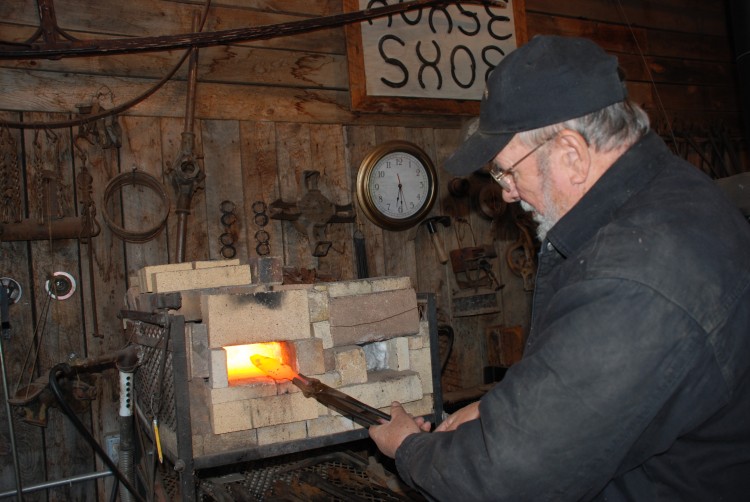
It begins with 5160 spring steel 1 ½“ wide and ¼” thick. “The length I chop up as I choose,” knife maker Greg Ferrier said. Greg spent 20 years as a B 52 crewman before retiring from the military. His passion for fine blades brought him to historic Ft. Hays outside Rapid City, South Dakota to work in a blacksmith shop.
“I go from here to there making a blade in 30 to 45 minutes if I keep my mouth shut and pay attention to what I’m doing.” Greg took the bar slab, cut to desired length, to his forge. He heated it until it was cherry red. The blade was removed and hammered on an anvil to flatten and shape the steel. In the hands of an expert the job looked easy. It required careful attention and the use of tongs to keep the metal in place while it was being hammered. The process might repeat itself several times before the bar steel was shaped.
Greg then lets the shaped blade cool. “I clean off the fire scale with a Makita right angle grinder with a 4” disk. If you put it on a belt grinder it will tear up one or two belts and they cost $5 each.”