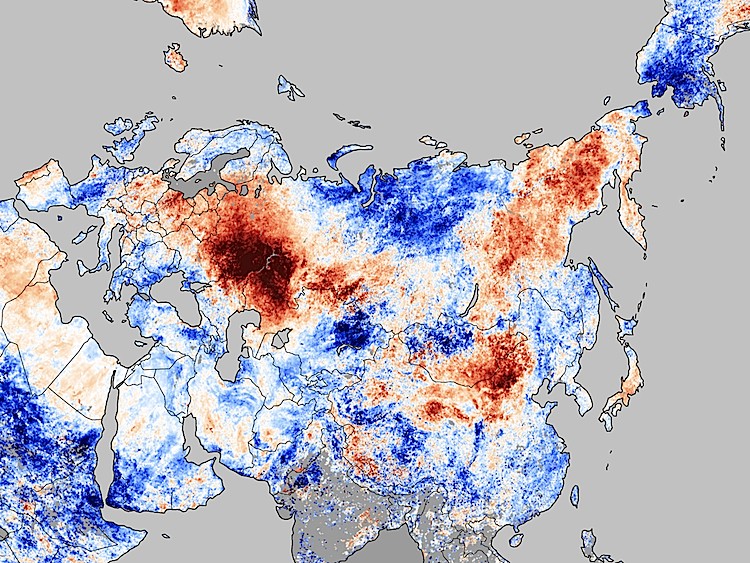
The Russian wildfires and Pakistan floods of 2010 were physically connected, according to new research from NASA.
Despite being separated both in time and by a distance of 1,500 miles (2,414 kilometers), both events were triggered by an abnormality in the Earth’s atmospheric patterns.
From mid-July to mid-August, a stagnant weather pattern called an Omega blocking event formed above western Russia and divided the jet stream.
This in turn slowed down the global westerly air currents or Rossby waves, which drive jet streams, altering the normal west to east progression of weather systems.
As a result, there was a shift in Indian monsoons and subsequent flooding in Pakistan starting in late July. Extreme heat and wildfires developed in Russia in early August.
“From NASA satellite data and wind analysis, we can clearly see the connection between the two events,” said co-author William Lau at NASA’s Goddard Space Flight Center in a press release.
“Think of the atmosphere like a loose membrane,” he added. “If you push one part up, something else has to come down somewhere else. If you produce a high in one region, you produce a corresponding low in another.”
It is unclear what caused the Omega blocking event. Based on atmospheric modeling, Lau suggested that a positive feedback cycle may have formed between the Earth’s surface and atmosphere, intensifying the heat wave.
The lack of clouds due to the high temperatures would have meant less shade and precipitation, further drying the soil and reducing the evaporation rate.
Also, black carbon in the form of wildfire smoke particles may have heated up and burned off cloud cover, adding to the feedback effect.
“We need more research to say for sure whether land and aerosol feedback sustained the high, but this study suggests it’s possible,” said Goddard scientist Ralph Kahn, who was not part of this research, in the release.
The paper is called “The 2010 Pakistan Flood and Russian Heat Wave: Teleconnection of Hydrometeorologic Extremes,” and was published online in the Journal of Hydrometeorology on Aug. 2.