


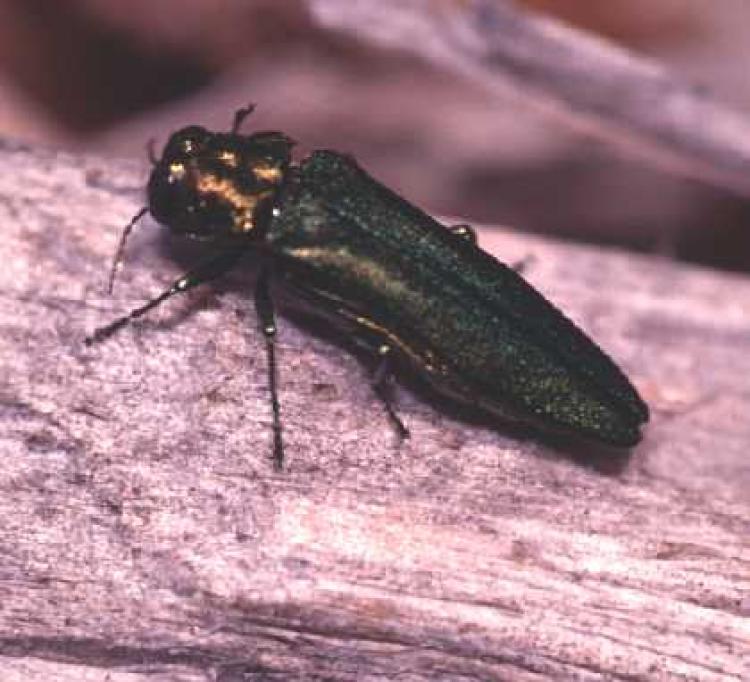
DETROIT—In 2002, the Emerald Ash Borer (EAB), a tiny green insect smaller than a penny, made its first appearance in North America, killing ash trees in the Detroit and Windsor area.
Originating in China, and other Eastern areas surrounding China, current theories hold that it was brought over in ash wood crates on cargo ships. According to the national Emerald Ash Borer Web site www.emeraldashborer.info, the EAB infests 10 states and two Canadian provinces. It kills ash trees by burrowing into and destroying the conducting tissues under the bark, and thereby cutting off vital nutrients and water. This results in loss of both tree canopy and trees, which threatens the ecological balance of areas with a high ash tree population.
Today, while states like Michigan are almost totally under quarantine due to multiple specimens or confirmed cases of EAB infestation, states like New York only have one confirmed case but are taking tremendous care not to spread this invasive beetle.
In response to the continued presence of EAB in the state of Michigan, the Michigan Department of Agriculture in conjunction with the Michigan Department of Natural Resources, Michigan State University, and the U.S Department of Agriculture, is implementing various strategies to reduce the threat of EAB.
These include continuously surveying possible problem areas, regulating ash wood movement, encouraging use of other types of hardwood, encouraging the establishment of more disposal sites for dead or infested wood throughout the state, and supporting restoration grants to replant trees in EAB-affected areas.
According to the Michigan Department of Agriculture, the best way to stop the spread of the Emerald Ash Borer is to respect quarantines implemented by each state, and to refrain from moving firewood from quarantined areas or planting new ash trees when 10 percent of local trees are of the ash variety.
Originating in China, and other Eastern areas surrounding China, current theories hold that it was brought over in ash wood crates on cargo ships. According to the national Emerald Ash Borer Web site www.emeraldashborer.info, the EAB infests 10 states and two Canadian provinces. It kills ash trees by burrowing into and destroying the conducting tissues under the bark, and thereby cutting off vital nutrients and water. This results in loss of both tree canopy and trees, which threatens the ecological balance of areas with a high ash tree population.
Today, while states like Michigan are almost totally under quarantine due to multiple specimens or confirmed cases of EAB infestation, states like New York only have one confirmed case but are taking tremendous care not to spread this invasive beetle.
In response to the continued presence of EAB in the state of Michigan, the Michigan Department of Agriculture in conjunction with the Michigan Department of Natural Resources, Michigan State University, and the U.S Department of Agriculture, is implementing various strategies to reduce the threat of EAB.
These include continuously surveying possible problem areas, regulating ash wood movement, encouraging use of other types of hardwood, encouraging the establishment of more disposal sites for dead or infested wood throughout the state, and supporting restoration grants to replant trees in EAB-affected areas.
According to the Michigan Department of Agriculture, the best way to stop the spread of the Emerald Ash Borer is to respect quarantines implemented by each state, and to refrain from moving firewood from quarantined areas or planting new ash trees when 10 percent of local trees are of the ash variety.
