

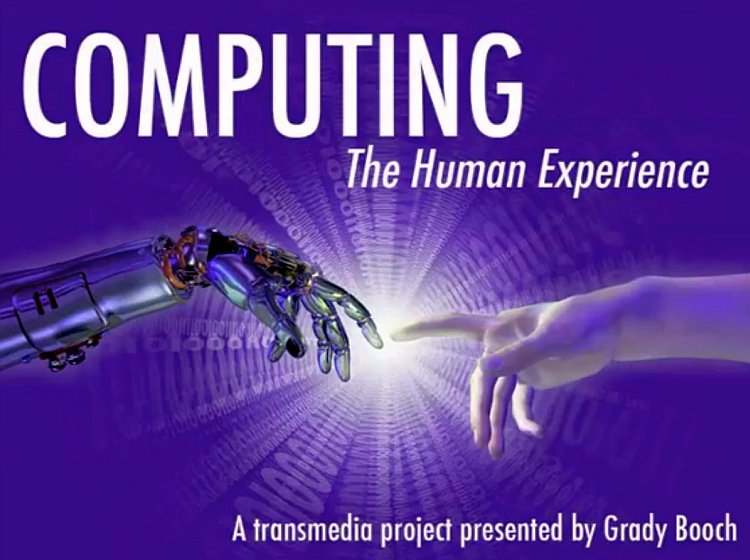
When computers emerged, we willfully followed them down every twist and turn—some good and some bad. In one lifetime, computers have grown to saturate nearly every element of life—¬from food transportation and household gadgets, to the cars we drive, to global finances.
By presenting this history, world-renowned computer scientist Grady Booch, and a team of experts in the field, hope to make us think about our relationships to computers and whether we choose to control our futures or be controlled by the very machines we created.
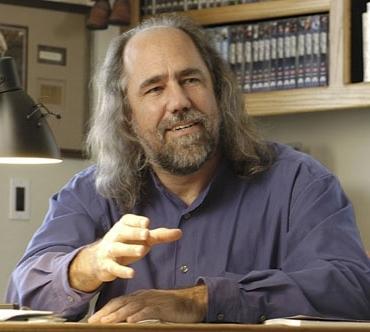
Booch will present this in a documentary series, “Computing: The Human Experience,” that he’s funding through Kickstarter. He is known for his work on several other projects, being an original creator of the Unified Model Language (UML), and helping to build Watson at IBM—which won a Jeopardy game against human players earlier this year.
“In a world with abundant computational power, where nothing is forgotten, and where we are connected in pervasive, unexpected ways beyond our choice, it is reasonable to stop and ask ourselves just what kind of world we hope to intentionally create,” Booch said via email.
“The goal of Computing: The Human Experience is to present a basic picture of the past and the present of computing so that we as a people can be intentional how about how we will shape the future of computing as well as how we might choose to be shaped by it,” he said.
According to Booch, the crossroad mankind has reached with the proliferation of computers “is a phenomenon that rises with every such disruptive event in the human story.”
“When Gutenberg began printing books, it challenged the power of the Church and fueled an informed middle class. When inventions such as the cotton gin, or the sewing machine, or the telephone reached critical mass, the world shifted. When the Manhattan Project reached its goal, the face of warfare and the fate of humanity was forever altered,” he said.
Yet with computing, there is a fundamental difference. The technology, according to Booch, “has a pervasive and immediate impact on every element of the human experience, thereby amplifying the good as well as the bad at a pace that outruns the ability of human culture to reasonably absorb it.”
Complex systems—including human civilization—share a common factor: they can only adapt by way of natural mechanisms that allow it to grow with the change. But if there is too much change at once, or if the disruptive force is too heavy, “then that system will collapse until it finds a new stable state,” Booch said.
“This is certainly the nature of computing. It is as if we have created a new world, and chosen to step inside it. We must take responsibility both for the creation as well as for surrendering ourselves to it,” he said.
While he is confident in human resilience, Booch said a key concern is the “growing imbalance in power between those who embrace and master computing and those who do not.”
Several problems come out from this. One is the “potential for economic and social disruption,” that not only makes public conversation difficult,but actively discourages public transparency, he said. “I morn the creation of profoundly stupid laws and cultural edicts made out of fear that amplify all of this.”
Meanwhile, the computer systems much of today’s world runs on is “quite frankly, more fragile than we may realize. With computing, we have formed structures to which we trust ourselves, our livelihood, our nations and that yet are far less stable than what any outsider may suspect.”
Making Computers Cool
While many a good geek loves hearing about the cyphers and gadgets that were the root of modern computing, making this interesting for everyone else is something Booch is putting a lot of work into.
He plans to focus on the people behind it all.
“I’m a great fan of Joseph Campbell and his exposition of the hero’s journey. Each of us, individually and in the context of various social structures, is the hero in our own unique journey…” he said.
“Therein, I think, is the hook: the history of computing is also the history of human needs.”
The story of computers is a story that ties into both our past and our future—one shaped by curiosity and imagination of a struggle for power and control.
“We will tell the story of computing through these human stories, and along the way, we will be able to teach some of the fundamental science of computing as well as attend to some of the important history of computing,” he said.
What the future holds for computing is often the burning question. Booch said that while he can speculate, he would rather explain its foundations and the growing forces, both good and bad, that come with it.
“We will set the stage, we will pose the questions, but our audience can draw their own conclusions…as well as hopefully be inspired to be part of creating that future,” he said.
The documentary will also break the film-only tradition and will instead take a transmedia approach. In addition to the broadcast series, Booch plans to create school materials, apps, games, in-person lecture series, and good ol' print.
The lecture series—which will be broadcasted and posted to the Web—will play a big part in this project. Booch is planning a lecture series to parallel each of the major themes they'll focus on. Two will be about the roots of computing, six on the interplay with the human experience, and three to explore its limits.
Nearly all of the major parts of modern computing were born from warfare. Booch noted, “von Neumann’s work was associated with the Manhattan Project; the Internet evolved from military technology designed for survivable communications in the event of nuclear war; we rely on GPS which was an outgrowth of a classified project for accurate targeting of ballistic missiles…The list goes on.”
Booch said the premise of one of the lectures is that “computing was once a companion to war, it is now an instrument of war, but it is becoming a means of war.”
“This topic is important, because it establishes the reality that—for better or worse—warfare has been an important force in shaping modern computing,” he said.
It started when computers were just human systems to calculate ballistic tables and navigation aids. Yet, it has grown into unmanned aerial vehicles, and a system of warfare dependent on computing.
“Cyber-warfare is the coming battleground, for when a nation’s people rely on computing, attacking those computing resources leads us back to the basics of warfare, which is the use of any and all means to break the will and the resources of those people,” he said.
Charting a Course
When all is said and done, a main goal of the project is to help the world step back from the systems we’ve become saturated in, give a clear look at them, and help us think about the direction we’re heading.
“One of our goals is to help the youth who were born into a digital world to understand that computing hasn’t always existed—that someone invented it and that they can choose to be a part of this incredibly exciting and challenging industry,” he said. “They can be the ones who invent the future. They can change the world through computing.”
“In a world where heroes are sports figures, movie stars, and entertainers it is important for youth today to see that there are heroes who are smart and who have used their minds to create heroic results,” he said.
On a broader scale, he hopes that educating the world about the technology they willfully surrender themselves to will help people regain control over their technology. “An educated populace is better able to reconcile its past, reason about its present, and be better able to shape its future,” Booch said.
“With ‘Cosmos,’ Sagan inspired a generation with the beauty and elegance of the universe; in ‘The Elegant Universe,’ Brian Greene explored quantum physics with the public; James Burke’s ‘Connections’ told the story of a number of technologies,” Booch said.
“No documentary project has yet covered computing in a similar scope or style, so—very much in the spirit of Sagan’s ‘Cosmos’—’Computing: The Human Experience' will inform, inspire, and entertain.”