

Twenty-one years ago, tens of thousands students and their supporters, from blue-collar workers to scholars, from street vendors to newspaper reporters, went to Tiananmen Square in Beijing, asking for democracy and an end to corruption.
The communist regime responded with tanks and guns. Afterward, all Chinese media uniformly condemned the peaceful protesters as “anti-revolutionists” and praised the soldiers who fired at the citizens as heroes—“guards of the republic.”
For 21 years, the media in China has been extremely quiet about the June 4 massacre. It’s a taboo for anyone to mention in public.
Twenty-one years later, something changed. On June 1, International Children’s Day, the Southern Metropolitan News published an interesting set of cartoons on page B16, the cartoon section. The set, titled “Fake Children But With True, Childlike Fun,” showed five children realizing their childhood dreams to become a doctor, teacher, singer, soldier, and painter, respectively.
For each person, there was a pair of cartoons: One showed the person’s current career, and the other one showed how the individual had practiced for his or her dream career when young. For example, the singer’s childhood story was a cute little girl singing with a fake microphone made with sticks and a bottle.
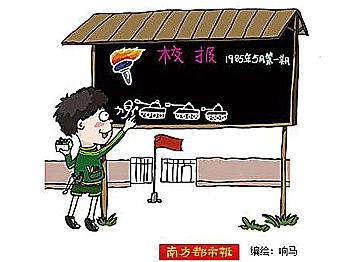
What really caught people’s attention was the childhood story of the painter. The young boy was sketching on a board. He drew three tanks in a line, with a person standing in front of the tanks. There were only a few stokes for the person, so it was hard to tell whether that was a soldier holding a submachine gun or a person standing in front of tanks.
Some websites immediately linked this cartoon to the “tank man” at Tiananmen Square in 1989. The “tank man” was Mr. Wang Ruilin. He stood in front of a queue of tanks that were advancing to Tiananmen Square under orders of martial law. He used his body to stop iron war machines.
[xtypo_dropcap]T[/xtypo_dropcap]he Southern Metropolitan News was praised by netizens for having subtly mentioned the Tiananmen Square massacre, in spite of the ban.
Whether the cartoon was intended to do that or it was just perceived as doing so, we don’t know. But the cartoon of the child sketching tanks was taken out of the cartoon set published on the Southern Metropolitan News website, leaving all the other people with a childhood story but a blank spot for the painter.
This is not the first time that the Southern Metropolitan News did something controversial from the point of view of the Communist Party’s Central Propaganda Department. Another example involves a commentary on the “hukou,” or household-registration system.
The communist regime responded with tanks and guns. Afterward, all Chinese media uniformly condemned the peaceful protesters as “anti-revolutionists” and praised the soldiers who fired at the citizens as heroes—“guards of the republic.”
For 21 years, the media in China has been extremely quiet about the June 4 massacre. It’s a taboo for anyone to mention in public.
Twenty-one years later, something changed. On June 1, International Children’s Day, the Southern Metropolitan News published an interesting set of cartoons on page B16, the cartoon section. The set, titled “Fake Children But With True, Childlike Fun,” showed five children realizing their childhood dreams to become a doctor, teacher, singer, soldier, and painter, respectively.
For each person, there was a pair of cartoons: One showed the person’s current career, and the other one showed how the individual had practiced for his or her dream career when young. For example, the singer’s childhood story was a cute little girl singing with a fake microphone made with sticks and a bottle.
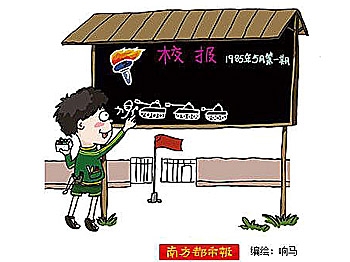
What really caught people’s attention was the childhood story of the painter. The young boy was sketching on a board. He drew three tanks in a line, with a person standing in front of the tanks. There were only a few stokes for the person, so it was hard to tell whether that was a soldier holding a submachine gun or a person standing in front of tanks.
Some websites immediately linked this cartoon to the “tank man” at Tiananmen Square in 1989. The “tank man” was Mr. Wang Ruilin. He stood in front of a queue of tanks that were advancing to Tiananmen Square under orders of martial law. He used his body to stop iron war machines.
[xtypo_dropcap]T[/xtypo_dropcap]he Southern Metropolitan News was praised by netizens for having subtly mentioned the Tiananmen Square massacre, in spite of the ban.
Whether the cartoon was intended to do that or it was just perceived as doing so, we don’t know. But the cartoon of the child sketching tanks was taken out of the cartoon set published on the Southern Metropolitan News website, leaving all the other people with a childhood story but a blank spot for the painter.
Emperor Comes Last
This is not the first time that the Southern Metropolitan News did something controversial from the point of view of the Communist Party’s Central Propaganda Department. Another example involves a commentary on the “hukou,” or household-registration system.
