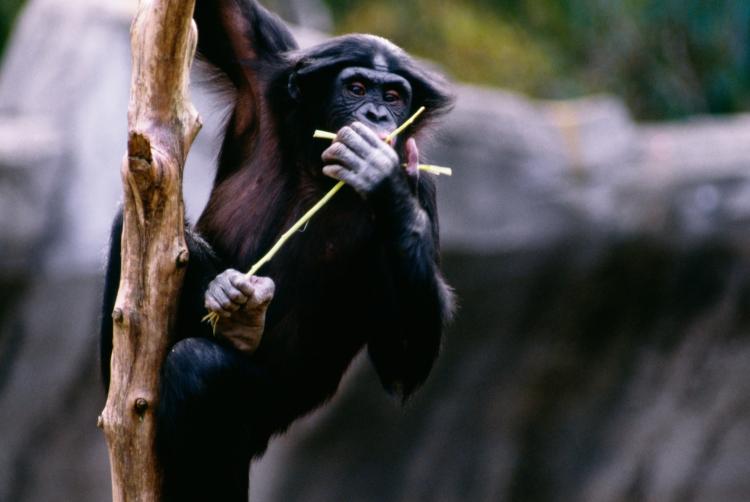
A 14-year study due to be published Dec. 21 in Current Biology has yielded evidence that juvenile chimpanzees play with sticks in their environment like human children play with dolls, and there is a difference between young male and female chimpanzees in how they handle their toys.
Dr. Sonya Kahlenberg of Bates College (previously a postdoctoral fellow at Harvard University) and Dr. Richard Wrangham of Harvard University conducted the study on the Kanyawara chimpanzee community at Kibale National Park, Uganda.
“Here we present the first evidence of sex differences in use of play objects in […] chimpanzees,” the researchers wrote in their paper. “We find that juveniles tend to carry sticks in a manner suggestive of rudimentary doll play and, as in children and captive monkeys, this behavior is more common in females than in males.”
A study published in 2008 found that when presented with human toys, captive rhesus monkeys’ preferences are like those of children—male monkeys preferred masculine toys like trucks while females preferred dolls.
From 1993 to 2006, Kahlenberg and Wrangham observed 301 occasions of chimpanzees using sticks, among which 38.9 percent was stick-carrying, defined as “holding or cradling detached sticks […], including pieces of bark, logs, and woody vine, in the hand, mouth, underarm or, most commonly, tucked between the abdomen and thigh.”
“Individuals carried sticks for periods of one minute to more than four hours during which they rested, walked, climbed, slept and fed as usual,” they wrote in the paper.
“Unlike other types of stick use, carried sticks were regularly taken into day-nests (on at least 25 occasions; 6 females, 2 males) where individuals rested and were sometimes seen to play casually with the stick,” they reported, and there was “no discernible function” in the stick-carrying behavior.
A 2005 book, “The Nature of Play: Great Apes and Humans,” documented cases of apes raised by humans directing care toward objects, as well as two detail reports of wild chimpanzees using sticks as dolls.
“At Kanyawara, an 8-year-old male carried and played with a small log for four hours and also made a separate nest for it; and while her mother was carrying her sick infant sibling, an 8-year-old female at Bossou (Guinea) carried a log, including patting it like ‘slapping the back of an infant.’” Kahlenberg and Wrangham summarized the reports in their paper.
In their study, Kahlenberg and Wrangham noted that “stick-carrying ceased with motherhood.” They had only encountered six instances of female adult chimpanzees carrying sticks, and they all occurred before the females had their first baby.
“We thought that if the sticks are being treated like dolls, females would carry sticks more than males do and should stop carrying sticks when they have their own babies,” Wrangham said in a press release. “We now know that both of these points are correct.”
“Sex differences in juvenile stick-carrying did not result from females observing their mothers carrying sticks, since mothers never carried sticks,” the researchers concluded in their paper. “Instead, youngsters apparently learned socially from each other.”
This is the first chimpanzee community where stick-carrying is observed because given their small sizes, chimpanzee communities usually have few young chimpanzees. More study is needed to determine whether this behavior is specific to the Kanyawara community, the researchers noted.
If stick-carrying is absent in other chimpanzee communities, “it will be the first case of a tradition maintained just among the young, like nursery rhymes and some games in human children,” Wrangham said in the press release.
“This would suggest that chimpanzee behavioral traditions are even more like those in humans than previously thought.”
Dr. Sonya Kahlenberg of Bates College (previously a postdoctoral fellow at Harvard University) and Dr. Richard Wrangham of Harvard University conducted the study on the Kanyawara chimpanzee community at Kibale National Park, Uganda.
“Here we present the first evidence of sex differences in use of play objects in […] chimpanzees,” the researchers wrote in their paper. “We find that juveniles tend to carry sticks in a manner suggestive of rudimentary doll play and, as in children and captive monkeys, this behavior is more common in females than in males.”
A study published in 2008 found that when presented with human toys, captive rhesus monkeys’ preferences are like those of children—male monkeys preferred masculine toys like trucks while females preferred dolls.
From 1993 to 2006, Kahlenberg and Wrangham observed 301 occasions of chimpanzees using sticks, among which 38.9 percent was stick-carrying, defined as “holding or cradling detached sticks […], including pieces of bark, logs, and woody vine, in the hand, mouth, underarm or, most commonly, tucked between the abdomen and thigh.”
“Individuals carried sticks for periods of one minute to more than four hours during which they rested, walked, climbed, slept and fed as usual,” they wrote in the paper.
“Unlike other types of stick use, carried sticks were regularly taken into day-nests (on at least 25 occasions; 6 females, 2 males) where individuals rested and were sometimes seen to play casually with the stick,” they reported, and there was “no discernible function” in the stick-carrying behavior.
A 2005 book, “The Nature of Play: Great Apes and Humans,” documented cases of apes raised by humans directing care toward objects, as well as two detail reports of wild chimpanzees using sticks as dolls.
“At Kanyawara, an 8-year-old male carried and played with a small log for four hours and also made a separate nest for it; and while her mother was carrying her sick infant sibling, an 8-year-old female at Bossou (Guinea) carried a log, including patting it like ‘slapping the back of an infant.’” Kahlenberg and Wrangham summarized the reports in their paper.
In their study, Kahlenberg and Wrangham noted that “stick-carrying ceased with motherhood.” They had only encountered six instances of female adult chimpanzees carrying sticks, and they all occurred before the females had their first baby.
“We thought that if the sticks are being treated like dolls, females would carry sticks more than males do and should stop carrying sticks when they have their own babies,” Wrangham said in a press release. “We now know that both of these points are correct.”
“Sex differences in juvenile stick-carrying did not result from females observing their mothers carrying sticks, since mothers never carried sticks,” the researchers concluded in their paper. “Instead, youngsters apparently learned socially from each other.”
This is the first chimpanzee community where stick-carrying is observed because given their small sizes, chimpanzee communities usually have few young chimpanzees. More study is needed to determine whether this behavior is specific to the Kanyawara community, the researchers noted.
If stick-carrying is absent in other chimpanzee communities, “it will be the first case of a tradition maintained just among the young, like nursery rhymes and some games in human children,” Wrangham said in the press release.
“This would suggest that chimpanzee behavioral traditions are even more like those in humans than previously thought.”