

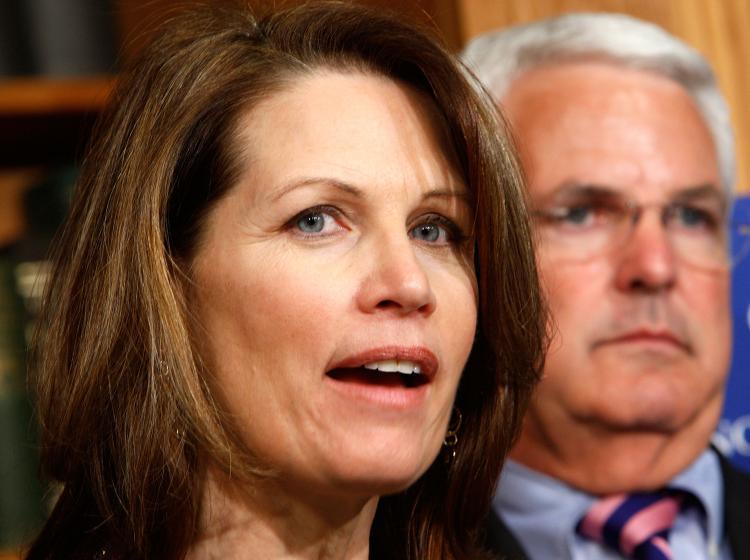
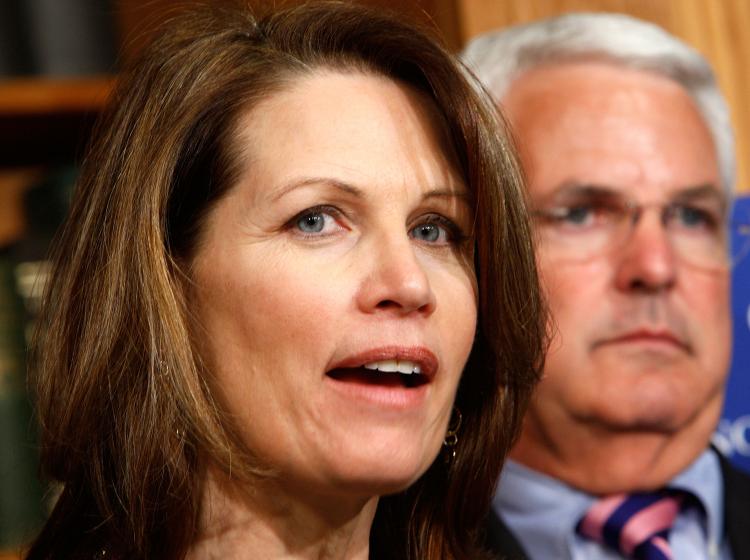
As Americans anticipated President Obama’s first State of the Union address dealing with renewed efforts to further his agenda, focus on the struggling economy and salvage health care reform, Republican representatives—led by Rep. Michele Bachmann (R-Minn.)—held a press conference at the U.S. Capitol Wednesday to unveil the Declaration of Health Care Independence .
“The Declaration of Health Care Independence is a commitment to protect the rights of the American people to make their own health care decisions, reduce bureaucratic red tape, [and] decrease intergenerational debt,” Rep. Bachmann stated, as quoted on her official Web site Bachmann.house.gov. “This is not a bill, but rather a roadmap of the rules going forward.”
The declaration, with a political nod to one of the United States’ founding documents—The Declaration of Independence—includes a preamble which rejects “the imposition upon us of a new, Washington-controlled system of government-run health care” and demands “constitutional protection of the right to make our own health decisions.”
The proposal itself does not specify the Republicans’ alternative plan for health care reform, but instead criticizes what it calls a federal “takeover of American health care.” The document goes further in warning that a “takeover” denies “fundamental personal and economic liberties,” imposes “increased costs and taxes” on citizens through mandates, and institutionalizes an “ever-expanding federal bureaucracy.”
Bachmann’s declaration, dealing mostly with generalizations, also requests a constitutional framework for dealing with future reform proposals, and states that federal “leaders have been deaf to the voice of the people.”
The proposed framework for future legislation specifies transparency and oversight in negotiations, prohibits funding of abortions, rejects increased debt and health care mandates, among other tenets.
The theme and wording of the declaration could be a nod to rising populism and the Tea Party movement, which is credited as a force behind the Jan. 19 election victory of Sen. Scott Brown in Massachusetts; a victory that sent a ripple through the corridors of Washington.
Rep. Bachmann acknowledged this when appearing on Fox’s “O’Reilly Factor” show on Tuesday. Host Bill O’Reilly asked whether the “Tea Party people” would become a “dominant force” behind the future Republican Party. “Oh, I think they will,” Ms. Bachmann said. “And if the Republican Party is smart, they will embrace the Tea Party movement.”
This populist trend may also be behind Obama’s proposal to cut domestic spending; a proposal in contrast to the administration’s actions and proposed spending in its first year of office.
An additional factor behind the change in strategy may be the release of a report by the Congressional Budget Office (CBO) on Tuesday which forecast a 2010 deficit of $1.35 trillion dollars—down slightly from last year’s record $1.4 trillion deficit for the fiscal year ending in Sept. 2009.
Democrats have argued that the bulk of this debt was accumulated under the Bush administration and the funding of wars in Iraq and Afghanistan, an argument which may be supported by CBO data. House Budget Committee Chairman John Spratt (D –S.C.) said in a statement that the report provided confirmation that “the recession inherited from the Bush administration continues to erode the budget’s bottom line,” according to the Wall Street Journal.
“The Declaration of Health Care Independence is a commitment to protect the rights of the American people to make their own health care decisions, reduce bureaucratic red tape, [and] decrease intergenerational debt,” Rep. Bachmann stated, as quoted on her official Web site Bachmann.house.gov. “This is not a bill, but rather a roadmap of the rules going forward.”
The declaration, with a political nod to one of the United States’ founding documents—The Declaration of Independence—includes a preamble which rejects “the imposition upon us of a new, Washington-controlled system of government-run health care” and demands “constitutional protection of the right to make our own health decisions.”
The proposal itself does not specify the Republicans’ alternative plan for health care reform, but instead criticizes what it calls a federal “takeover of American health care.” The document goes further in warning that a “takeover” denies “fundamental personal and economic liberties,” imposes “increased costs and taxes” on citizens through mandates, and institutionalizes an “ever-expanding federal bureaucracy.”
Bachmann’s declaration, dealing mostly with generalizations, also requests a constitutional framework for dealing with future reform proposals, and states that federal “leaders have been deaf to the voice of the people.”
The proposed framework for future legislation specifies transparency and oversight in negotiations, prohibits funding of abortions, rejects increased debt and health care mandates, among other tenets.
Populist Influence
The theme and wording of the declaration could be a nod to rising populism and the Tea Party movement, which is credited as a force behind the Jan. 19 election victory of Sen. Scott Brown in Massachusetts; a victory that sent a ripple through the corridors of Washington.
Rep. Bachmann acknowledged this when appearing on Fox’s “O’Reilly Factor” show on Tuesday. Host Bill O’Reilly asked whether the “Tea Party people” would become a “dominant force” behind the future Republican Party. “Oh, I think they will,” Ms. Bachmann said. “And if the Republican Party is smart, they will embrace the Tea Party movement.”
This populist trend may also be behind Obama’s proposal to cut domestic spending; a proposal in contrast to the administration’s actions and proposed spending in its first year of office.
An additional factor behind the change in strategy may be the release of a report by the Congressional Budget Office (CBO) on Tuesday which forecast a 2010 deficit of $1.35 trillion dollars—down slightly from last year’s record $1.4 trillion deficit for the fiscal year ending in Sept. 2009.
Democrats have argued that the bulk of this debt was accumulated under the Bush administration and the funding of wars in Iraq and Afghanistan, an argument which may be supported by CBO data. House Budget Committee Chairman John Spratt (D –S.C.) said in a statement that the report provided confirmation that “the recession inherited from the Bush administration continues to erode the budget’s bottom line,” according to the Wall Street Journal.


