

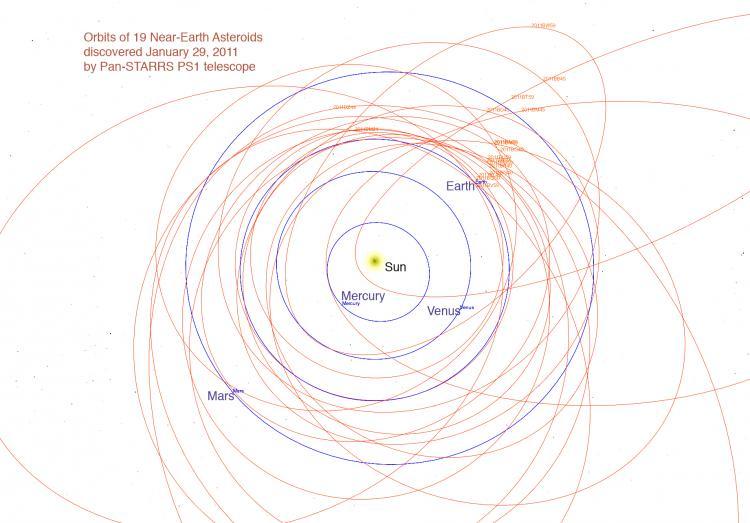
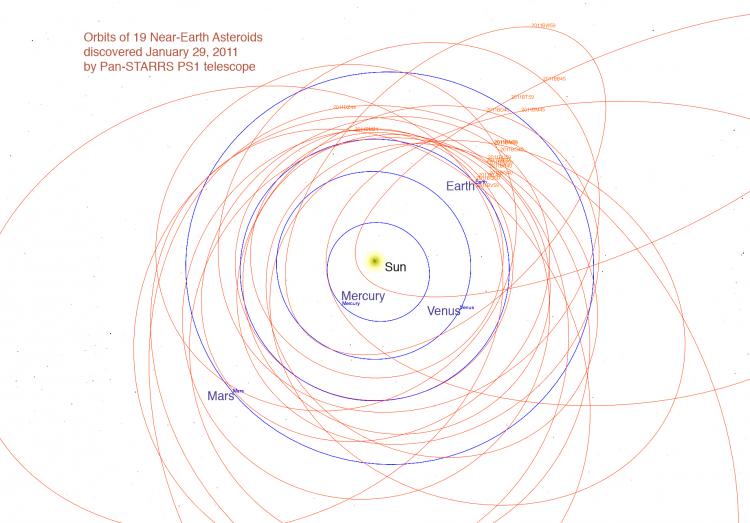
Astronomers in Hawaii discovered 19 near-Earth asteroids on the night of Jan. 29 using the Pan-STARRS PS1 telescope, a record discovery for one telescope in a single night.
That night, Larry Denneau, a Pan-STARRS software engineer, stayed up to process all the PS1 data. By the following afternoon, the total number of potential near-Earth asteroids spotted by Denneau and colleagues had reached 30.
The team submitted their data to the Minor Planet Center in Cambridge, Ma., for the objects to be confirmed as asteroids. Asteroid discoveries can be made official by re-observation several times within 12 to 72 hours to ascertain their orbits before they disappear from view.
Two asteroids were confirmed on Jan. 30 and nine more on Jan. 31, despite snow and fog interfering with telescope observations. Seven discoveries were confirmed with the aid of telescopes from all over the world, including Italy, Japan, and the United Kingdom.
“This record number of discoveries shows that PS1 is the world’s most powerful telescope for this kind of study,” said Nick Kaiser, head of the Pan-STARRS project, in a University of Hawaii press release. “NASA and the U.S. Air Force Research Laboratory’s support of this project illustrate how seriously they are taking the threat from near-Earth asteroids.”
“Usually there are several mainland observatories that would help us confirm our discoveries, but widespread snowstorms there closed down many of them, so we had to scramble to confirm many of the discoveries ourselves,” said Richard Wainscoat from University of Hawaii’s Institute for Astronomy, in the release.
Of particular interest are two asteroids with orbits that bring them very close to Earth’s orbit. The astronomers will be watching these two asteroids closely as a collision with our planet could occur during the next 100 years, although there is no immediate danger.
That night, Larry Denneau, a Pan-STARRS software engineer, stayed up to process all the PS1 data. By the following afternoon, the total number of potential near-Earth asteroids spotted by Denneau and colleagues had reached 30.
The team submitted their data to the Minor Planet Center in Cambridge, Ma., for the objects to be confirmed as asteroids. Asteroid discoveries can be made official by re-observation several times within 12 to 72 hours to ascertain their orbits before they disappear from view.
Two asteroids were confirmed on Jan. 30 and nine more on Jan. 31, despite snow and fog interfering with telescope observations. Seven discoveries were confirmed with the aid of telescopes from all over the world, including Italy, Japan, and the United Kingdom.
“This record number of discoveries shows that PS1 is the world’s most powerful telescope for this kind of study,” said Nick Kaiser, head of the Pan-STARRS project, in a University of Hawaii press release. “NASA and the U.S. Air Force Research Laboratory’s support of this project illustrate how seriously they are taking the threat from near-Earth asteroids.”
“Usually there are several mainland observatories that would help us confirm our discoveries, but widespread snowstorms there closed down many of them, so we had to scramble to confirm many of the discoveries ourselves,” said Richard Wainscoat from University of Hawaii’s Institute for Astronomy, in the release.
Of particular interest are two asteroids with orbits that bring them very close to Earth’s orbit. The astronomers will be watching these two asteroids closely as a collision with our planet could occur during the next 100 years, although there is no immediate danger.


