


Alberto Contador put in a great ride, matching every acceleration up the climbs and contesting the final sprint when the peloton reached the finish line.
But the story of the day was Lance Armstrong, who exploded out of the peloton to chase an attack by the Schleck brothers, dropping riders like Christian Vande Velde and Kim Kirchen. Armstrong stood up and sprinted up the mountain, chasing down the Schlecks and the yellow jersey, preserving his second place overall and keeping Astana strong in the GC.
‘Looking for a little bit of steep road’
“I sort of got left out of the acceleration caught by surprise,” Armstrong explained. “There wasn’t much I could do. I sat with a few guys; fortunately some of them were riding with pretty good tempo, keeping it close, but I realized that the race was going up the road so … I figured I’d give it a shot.
“I didn’t expect to make it across as quickly as I did, but … it felt good. It was a good day.
Armstrong explained that, once he decided not to get left behind, he had to wait for an opportunity.
“The Petit St. Bernard is not that steep. You’ve got to find that moment … it’s sort of rolling along at six percent, so you’ve got to find a seven or an eight [percent incline] before you can make an acceleration; otherwise all the guys follow you. So I was just looking for a little bit of steep road.”
Armstrong was asked if he felt like the “old” Lance Armstrong on today’s climb.
“That acceleration felt a little bit like it. I still maintain I can’t accelerate like these young kids can.
“Maybe today also in the back of my mind I wanted to ride my race, my tempo, like I didn’t do the other day—but, then I got left behind.”
Because of the efforts of Lance Armstrong and Alberto Contador, Team Astana maintains its hold on the first two places in the General Classification, with teammate Adréas Klöden sitting fourth.
Stage Seventeen, 170 km from Bourg-Saint-Maurice to Le Grand-Bornand, contains five categorized climbs, none of them less than seven percent average incline.
As Saxo Bank rider Andy Schleck put it: “Tomorrow is a day where the Tour can be decided. We are ready; we are looking forward to tomorrow, and hope for a good race.”
Lance Armstrong said, “We’ll see tomorrow. Tomorrow will be an up and down day, and probably a day of attrition. Hopefully I’ll be there”
Hard Up, Fast Down
Stage Sixteen, 159 km from Martigny to Bourg-Saint-Maurice, started steep and stayed steep, with an Hors Categorie climb, a long, frighteningly fast descent, a Cat. One climb, and another long, tricky descent to the finish line. The stage favored strong climbers, but even more skilled descenders.
In Stage Thirteen, Cervelo rider Heinrich Haussler, dropped Quickstep rider Sylvain Chavanel on the descent down the Col du Platzerwasel, simply by being more skilled at that one aspect of bike racing.
In Stage Sixteen, a good climber could get caught up by a great descender; and the stage ended with a descent.
Some teams were planning to attack on the first climb; certainly any rider in contention would attack on the second climb. The stage promised action.
‘Mountain King’ Attacks
The first attack came 500 meters into the race, as a group of twenty-one riders tried to get an advantage up the hill before the big climbers got started. Franco Pellizotti, and Egoi Martinez, Vladimir Karpets attacked ten kilometers in; Martinez dropped off, but Pellizotti and Karpets kept away. Pellizotti wore the “King of the Mountains” jersey as the rider first over the most climbs in the Tour. He was out to protect his title, it seemed.
Johann Bruyneel told his Team Astana riders on their race radios, “Well, done, good job. We do our own tempo here. We control the peloton—no need to worry about the breakaway.”
Astana maintained their usual tactic of using its power to drive the peleton so fast, most riders could not unleash a burst of speed sufficient to escape.
Franco Pellizotti and Vladimir Karpets held a lead of one-and-a-half to two minutes through most of the climb. For a while the chase group kept attracting more riders, swelling above two dozen, but Astana kept the pace so high, many riders could not keep away and dropped back into the peloton.
Though the Col du Grand-Saint-Bernard has an average slope of just over six percent, the top two kilometers climb at over ten percent. As the incline increased, the attackers slowed, while Team Astana kept pushing their high tempo, designed to exhaust threats before they could materialize.
This has been the mark of Team Astana throughout the Tour. By riding as a team, rather than as a group of individual riders, Astana has blunted many assaults and kept itself well-positioned to win the Tour overall. Attackers have to work so hard to open a gap, they cannot maintain their escapes. Astana seemingly plans to drain the competition so that as the Tour goes on, the other riders slow down, leaving Astana’s big guns ready for the final attack for the win.
The team does not have many stage wins, but the only stage win that truly matters is the last one.
Astana slowed a bit on the descent, knowing the real attacks would come on the final climb up the Col du Petit-Saint-Bernard. Astana didn’t want to risk accidents, opting to give up a few seconds to the chase group instead.
On the team radio, Johann Bruyneel told his riders to let the gap grow; the other teams would start chasing the breakaway, because they had more time to make up, and Astana could let the other teams do some work, to save their legs for the final climb.
The Final Climb
When the peloton reached the final climb, Astana throttled down, saving their energy. Other teams needed to attack—Cadel Evans of Silence-Lotto, the Schleck brothers of Saxo Bank—because they were minuets down and needed to make up time at every chance.
The chase group caught up with Pellizotti and Karpets; the chase group opened a gap of four minutes over the peloton. This group, now eighteen strong, picked up their pace, trying to shake out the weaker riders.
Attacks launched and crashed endlessly; Lefevre, Pellizotti, Fedrigo, Van Den Broek, Verdugo made efforts and fell back. Eventually, Jürgen Van Den Broek opened a gap; Franco Pellizotti rode with him. Mikel Astarloza made an Herculean effort to cross the gap to these two. Just short of the peak, Amaêl Moinard crossed over.
At this point there were two races: the race for the stage win, and the race for GC time.
With 115 km gone, Saxo Bank moved to the head of the peloton, picking up the pace considerably. This dropped a number of riders. Once Saxo started, Cadel Evans moved to the front, readying his move.
Chris and Nicki Sørenson led the peloton at a devastating pace, dropping all but three Astana riders: Klöden, Armstrong, and Contador.
120 km, in Andy Schleck attacked. Alberto Contador and Andréas Klöden from Astana, and Bradley Wiggins of Grmin, and Vincenzo Nibali of Liquigas went with him. Frank Schleck rode to protect his brother, but eventually dropped. Andy Schleck attacked repeatedly, but he couldn’t shake the others.
Suddenly with 35 kilometers to go, Lance Armstrong exploded up the mountainside, crossing over to the yellow jersey. Kim Kirchen rode with him, but fell off; Christian Vande Velde and then Rigoberto Uran followed, but they fell off too. Armstrong simply sprinted away from all the younger riders. This gave Astana incredibly power at the front: first, second, and fourth in GC, riding together, while the other leaders were riding without support.
Downhill Racers
Over the crest, the yellow jersey group caught up with some of the chase group, while four riders attacked: Stephane Goubert Sandy Casar Nicholas Roche Pierrick Fedrigo made a huge attempt to catch the lead four.
The yellow jersey group picked riders as it picked up speed, but no one was trying to catch the leaders. None of these riders could afford to crash and lose valuable seconds.
With ten kilometers to go, the four leaders had a stable fourteen-second lead over the four chasers, who were one minute fifteen seconds behind.
Dave Zabriskie of Garmin-Slipstream took the lead in the peloton, and rode a tremendous pace, determined to open gaps over all the riders who fell off over the climb. Riders like Cadel Evans were losing precious time as the peloton snaked though endless hairpin switchbacks, testing bike-handling skills and courage.
On the descent Jens Voigt crashed hard aft fifty miles per hour. The doctor’s car arrived almost immediately. Voigt remained conscious and apparently was not seriously injured, but it is doubtful he will continue the race.
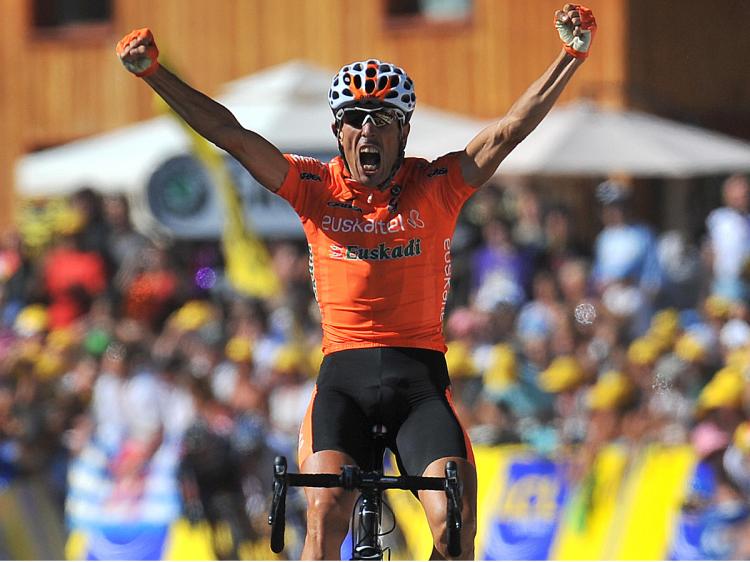
With three km to go, the four chasers were within 100 meters of the four leaders. With two km left, while the other leaders were looking back, Mikel Astarloza attacked, catching the others off guard. The two groups came together behind, and they all slowed, planning their own attacks for second place; they let Astarloza have the win.
Saxo Bank rider Andy Schleck’s team did not have a good day on the slopes of the Cols du St, Bernards. “We tried to gain time back,” he explained. “We attacked, it [the peloton] split up but the descent was really long,” which allowed riders to catch up. “It was a hard climb but it wasn’t hard enough” to separate out enough riders.
“I heard we lost Jens. I heard he crashed pretty bad. I am still waiting for information. So it was not a good day for us.”
He commented on the fact that Alberto Contador had countered all attacks.
“[Contador ] responded of course … but he will be very tired one day; maybe it will be tomorrow. Tomorrow is a day where the Tour can be decided. We are ready we are looking forward to tomorrow, and hope for a good race.”
| Stage 16 Results |
| General Classification After Stage 16 | ||||||||
|
| Rider | Team | Time | Gap |
| Rider | Team | Time | Gap | |
| 1 | Mikel Astarloza | Euskadi | 4:14:20 |
| 1 | Alberto Contador | Astana | 67:33:15 |
| |
| 2 | Sandy Casar | FDJ | 4:14:26 | +00:06 | 2 | Lance Armstrong | Astana | 67:34:52 | +01:37 | |
| 3 | Pierrick Fedrigo | Bbox | 4:14:26 | 00:06 | 3 | Bradley Wiggins | Garmin-Slipstream | 67:35:01 | +01:46 | |
| 4 | Nicolas Roche | AG2R | 4:14:26 | 00:06 | 4 | Andréas Klöden | Astana | 67:35:32 | +02:17 | |
| 5 | Jurgen Van Den Broek | Wiggins | 4:14:26 | 00:06 | 5 | Andy Schleck | Saxo Bank | 67:35:41 | +02:26 | |
| 6 | Amaêl Moinard | Cofidis | 4:14:26 | +00:06 | 6 | Vincenzo Nibali | Liquigas | 67:36:06 | +02:51 | |
| 7 | Franco Pellizotti | Liquigas | 4:14:31 | +00:11 | 7 | Christophe Le Mevel | FDJ | 67:36:24 | +03:09 | |
| 8 | Stephane Goubert | AG2R | 4:14:31 | +00:11.9 | 8 | Frank Schleck | Saxo Bank | 67:36:40 | +03:25 | |
| 9 | Christophe Moreau | Agritubel | 4:15:19 | +00:59 | 9 | Carlos Sastre | Cervelo | 67:37:07 | +03:52 | |
| 10 | Alberto Contador | Columbia-HTC | 4:15:19 | +00:59 | 10 | Christian Vande Velde | Garmin-Slipstream | 67:37:14 | +03:59 | |


