The forays of Chinese aerospace weaponeers into better and more—many more—ballistic missiles, fighter jets, instruments of electronic warfare, and, potentially, near space-based sensor architecture, all generously funded with the deep pockets of the Chinese Communist Party, should alarm security experts and may redefine political and military dynamics in the Asia-Pacific region, according to a U.S. think tank.
In reports published this year and last year and in recent speeches, researchers from the Project 2049 Institute in Washington have painted a detailed and discomfiting picture of the CCP’s modernization of its military forces in aerospace—meaning those that roam both air and space.
Mark Stokes, Executive Director of the Institute, which was established in January 2008 to “guide decision makers toward a more secure Asia by the century’s mid-point,” presented the organization’s most recent thinking on the issue at the John Hopkins University’s School of Advanced International Studies on Oct. 13.
“The gradual expansion of China’s long range precision strike capabilities is altering the regional strategic landscape,” Stokes said.
Currently, missiles are a major plank in this aerospace power.
“These missiles give military planners a headache,” Stokes said. “If you have missiles that are highly accurate, how can you launch air operations, how can you protect ships at sea? These missiles pose a challenge for Taiwan to defend itself.”
This refers primarily to the CCP’s short range missile capability, which Project 2049 says has been a primary instrument for the CCP to exert psychological and political intimidation, particularly against the diminutive Taiwan.
The CCP has an inventory of at least 1,300 Short Range Ballistic Missiles, and recently, dozens or possibly hundreds of Medium Range Ballistic Missiles
Beyond the raw number of missiles, the real capability to launch them simultaneously or in short order is provided by the number of active “launchers.”
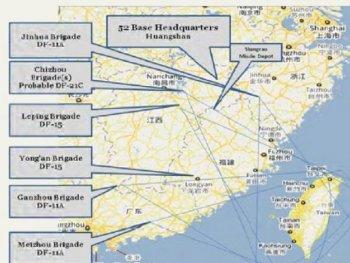
The People’s Liberation Army Air Force brigades—the unit of forces that manage missiles—generally have six battalions with two companies, each company having two or three launchers. Thus, five brigades—the number that have been aimed at Taiwan for close to two decades—could launch hundreds of salvos within a few hours notice. That only goes for Short Range Ballistic Missiles.
In reports published this year and last year and in recent speeches, researchers from the Project 2049 Institute in Washington have painted a detailed and discomfiting picture of the CCP’s modernization of its military forces in aerospace—meaning those that roam both air and space.
Mark Stokes, Executive Director of the Institute, which was established in January 2008 to “guide decision makers toward a more secure Asia by the century’s mid-point,” presented the organization’s most recent thinking on the issue at the John Hopkins University’s School of Advanced International Studies on Oct. 13.
“The gradual expansion of China’s long range precision strike capabilities is altering the regional strategic landscape,” Stokes said.
Currently, missiles are a major plank in this aerospace power.
“These missiles give military planners a headache,” Stokes said. “If you have missiles that are highly accurate, how can you launch air operations, how can you protect ships at sea? These missiles pose a challenge for Taiwan to defend itself.”
This refers primarily to the CCP’s short range missile capability, which Project 2049 says has been a primary instrument for the CCP to exert psychological and political intimidation, particularly against the diminutive Taiwan.
The CCP has an inventory of at least 1,300 Short Range Ballistic Missiles, and recently, dozens or possibly hundreds of Medium Range Ballistic Missiles
Beyond the raw number of missiles, the real capability to launch them simultaneously or in short order is provided by the number of active “launchers.”
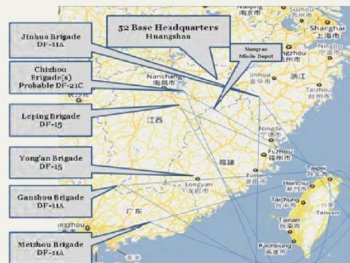
The People’s Liberation Army Air Force brigades—the unit of forces that manage missiles—generally have six battalions with two companies, each company having two or three launchers. Thus, five brigades—the number that have been aimed at Taiwan for close to two decades—could launch hundreds of salvos within a few hours notice. That only goes for Short Range Ballistic Missiles.