
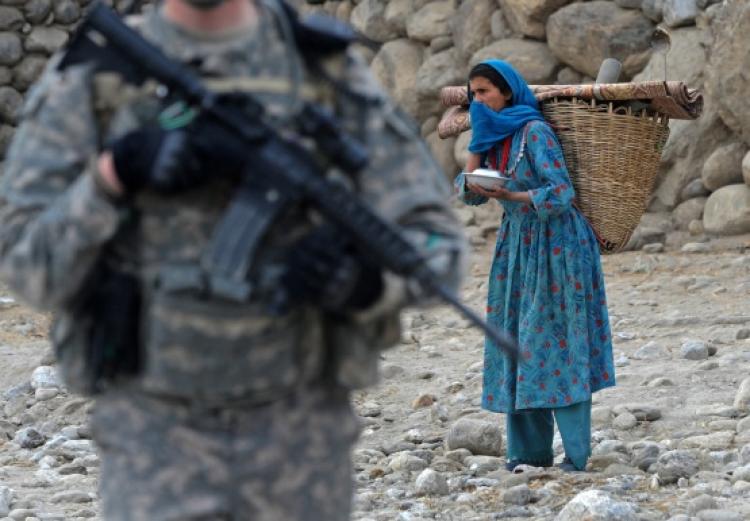
One month later, 800 Marines deployed from helicopters and swept across the district on foot, establishing patrol bases in villages and working with the local populace. Cooperation with the locals changed the situation dramatically.
“Insurgents find it substantially more difficult to operate without being ostracized or reported by farmers; government officials meet regularly with citizens to address their grievances, removing this powerful instrument of local control from the Taliban’s arsenal; the district center has transformed from a ghost town into a bustling bazaar,” says a report released by top U.S. intelligence officer Major General Michael Flynn on Monday.
This lesson, and others, are driving a re-evaluation of the strategy used by U.S. intelligence forces in Afghanistan. The report calls for sweeping changes in intelligence operations, including a bottom-up intelligence channel rather than the top-down system currently used.
Flynn’s report pulls from discussions with hundreds of people inside and outside the intelligence community. It is co-authored by Marine Captain Matt Pottinger and Paul Batchelor from the Pentagon’s Defense Intelligence Agency.
If its suggestions are used, the report could bring about major changes in the war in Afghanistan. Flynn works under General Stanley McChrystal, the top U.S. commander in Afghanistan—who backs the report, a U.S. forces spokesman told CNN.
Insurgent Obsession
The report argues that because the U.S. has focused “the overwhelming majority of collection efforts and analytical brainpower on insurgent groups,” the intelligence operatives are unable to answer even “fundamental questions” about the local environment or the Afghan people who they are trying to protect.“This problem or its consequences exist at every level of the U.S. intelligence hierarchy, and pivotal information is not making it to those who need it,” says the report.
Rather than working on building relationships with the locals, a reactive mode predominates U.S. intelligence operations—busy chasing down insurgents who planted improvised explosive devices (IED) and finding insurgents who are setting up ambushes and bomb attacks.
These are important elements, the document agrees, yet a sole focus on them has been preventing the U.S. from “finding ways to strike at the very heart of the insurgency.”
A problem in the current, reactive method is that “merely killing insurgents usually serves to multiply enemies rather than subtract them,” the report says. It references the Soviet’s failed war in Afghanistan in the 1980s, “When, despite killing hundreds of thousands of Afghans, they faced a larger insurgency near the end of the war than they did at the beginning.”
This is a serious issue in a war where success is dependent on whether the U.S. and its allies can gain the trust of the locals and establish a solid government in the country.
Ruining relations with an influential tribe can be detrimental. In such a case, “public confidence in the government’s ability to hold the entire city might easily, and predictably, falter,” says the report, suggesting that work needs to be done with helping the locals, such as helping with a quick irrigation project to help the community—things that the locals see as valuable as opposed to things the U.S. sees as valuable, such as a road in an area where cars may be scarce.
“A military force, culturally programmed to respond conventionally (and predictably) to insurgent attacks, is akin to the bull that repeatedly charges a matador’s cape—only to tire and eventually be defeated by a much weaker opponent,” General McChrystal is cited saying, “This is predictable—the bull does what comes naturally. While a conventional approach is instinctive, that behavior is self-defeating.”
“These labor-intensive efforts, employed in isolation, fail to advance the war strategy and, as a result, expose more troops to danger over the long run,” says the report.
The lesson from the Marines in Nawa and other areas, where teaming with the locals brought better results than fighting insurgents, underlies the message of the report. The locals “are far better than outsiders at spotting insurgents and their bombs, and providing indications and warnings” before bombs blow up and soldiers’ lives are lost, it argues.
A Bottom-up Structure
The soldiers on the battlefield are usually the best informed about enemy insurgents, while “moving up through levels of hierarchy is normally a journey into greater degrees of cluelessness,” the report says.
“It is little wonder, then, given the flow and content of today’s intelligence, that they are seriously frustrated with higher commands. For them, the relationship feels like all ‘give’ with little or nothing in return.”
Much of the enemy data given to soldiers on the field—usually regarding IEDs—is information the soldiers on the ground often already know, and the soldiers on the ground, “in many cases” are the ones who gave the information in the first place. Because of this, officers are turning to U.S. newspapers for their information instead of official documents, and intelligence officials are wasting their time.
What commanders want and need is information regarding the local population. Because of this need, the report encourages collecting data from “open-source” channels such as civilian sources, NGOs, and other groups.
“The Cold War notion that open-source information is ‘second class’ is a dangerous, outmoded cliché,” the document says. “Lieutenant General Samuel V. Wilson, former director of the Defense Intelligence Agency, captured it perfectly: ‘Ninety percent of intelligence comes from open sources. The other 10 percent, the clandestine work, is just the more dramatic. The real intelligence hero is Sherlock Holmes, not James Bond.’”