“Before I came to your hometown, I had thought it was a deserted place set in barren mountains; now that I’ve visited your hometown I know it’s filled with the fragrance of flowers. Before I met you, I had thought you were a primitive people; now we’ve come to know each other, so I know you are really a noble nation.”
These are the lyrics of a Tibetan folk song Ms. Zhu Rui, a writer of Han nationality, first heard at a Tibetan’s home, and these words expressed exactly how she felt about Tibet.
Growing up in mainland China, Ms. Zhu went through a transformation from having a distorted image of Tibet, to loving its culture and people after she visited there. Now an immigrant in Canada, she can’t seem to get Tibet out of her mind. Tibet has become a part of her life, like her pulse and breathing. That distant and mysterious land lies right at her life’s turning point and has been leading her toward milestone after milestone in her literary creations.
As Tibet is now the focus of international attention, the Epoch Times interviewed Ms. Zhu Rui in Canada, and asked her how she viewed Tibet, Tibetans, and their culture. During the interview her sensitive mind and soul took us on a journey, exploring that beautiful yet unfortunate snowy plateau.
My First Visit to Tibet: Chinese Han - Tibetan Conflicts
Ms. Zhu Rui: When I was young I had numerous meetings at which we were asked to recall the bitter past and be thankful for the sweet present. At that time, my impression about Tibet was that it was not only undeveloped, but also barbarous and to be feared. But later my perception of it changed.
It became a civilized, clean and picturesque place. I can’t pinpoint the exact cause of that change, as it is too distant in my memory. Like most Chinese, I was brainwashed by communist propaganda. Whatever was said about Tibet was not good, and I accepted that it was not good. In the 1980s, the Chinese communist regime seemed quiet on many sensitive issues—including on Tibet—and many works on Tibet from different angles appeared in China. I even found books on Tibet by foreign writers, and I became interested in the region.
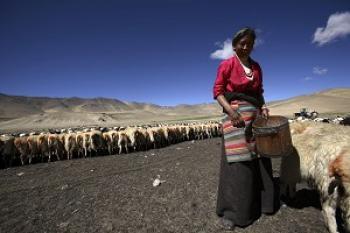
My first trip to Tibet took place in 1997. On our drive to Bird Island in Qinghai Province, I saw the first Tibetan tent, so I asked our driver to stop the van. As we started toward the tent, the people in it, a Tibetan woman and her husband and two children, came out greeting us. Happily, they ushered us in and treated us with their favorite food: butter tea, and they offered their only cushion for us to sit on.
I left the hostess 10 yuan (approx. US$1.4) before we left. But another Han woman in our van asked the Tibetan woman, “Other people all practice family planning. How come you have two children?”
Back in the van, one of us exclaimed, “Tibetans are really poor!” Another one said, “Poor? Isn’t it good here?! These pastures are all free!” Hearing their conversation, thinking about how that Tibetan woman treated us with the best they had without seeking anything in return from us, my heart felt heavy.
As we reached a desolate stretch of land on our drive on the Qinghai-Tibetan highway, we saw a Tibetan couple with the wife carrying a baby walking on the side of road. They waved to us, wanting a lift. So I said to the driver, “Shall we give them a ride?” As if he didn’t hear my words, the driver stepped on the gas and the van moved faster. “Why didn’t you stop the van?” I asked. “It’ll be beyond the capacity of the van,” he replied. “It’s not true. We can take six or seven more passengers. They are so helpless in this deserted area. If we don’t give them a hand, who knows how long it will be, before they can expect to see another vehicle coming? Why can’t we help them?” “You are so naïve. You don’t know that Tibetans are dirty. If you allow them to step onto the van, you’ll all hate the odor on them.”