


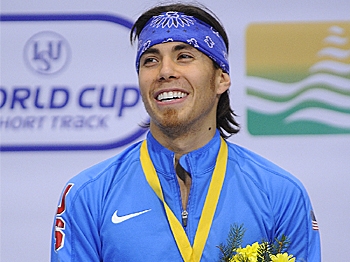
Unlike “long-track” speed skating, where two competitors race against the clock in separate lanes on a 400-meter track, short track speedskating is wide open—and physical.
There are no defined lanes, and the entire field of up to six racers start en masse. The race is won by the first across the line, so collisions and falls are not infrequent, as racers jostle for the best position. Short track speedskating has been compared to roller derby—you have to be fast, but it doesn’t hurt to know how to use the elbows either.
America’s brightest hopes for short track success lie with Apolo Anton Ohno, a 28-year-old Seattle resident who has brought home medals in two Olympics. In fact, with five medals to his credit, Ohno is within a medal of being the most decorated Winter Olympian in U.S. history.
The idea of winning medals isn’t what motivates him. “I am just trying to be the best that I can be. If I happen to win more medals, it will be icing on the cake,” Ohno told Sports Illustrated.
“For me it is much bigger than trying to always overdo myself. First and foremost I love my sport, I love what I do. It’s so extremely challenging, so rewarding in so many ways. I’m not even talking about competing but the struggle and the journey I face every single day when I am training and along the way—that’s what I enjoy.”
Ohno didn’t start skating until he was 13, but he started fast. After just six months of training, Ohno won the overall title at the U.S. Championships.
Within two years he was the top short track skater in the country. At 16, he failed to qualify for the 1998 Olympics due to fitness problems, but this only increased his desire.
Not making the Olympic team didn’t slow Ohno down at all. He became a dominant force in international as well as U.S. speedskating, eventually winning the World Cup overall championship in 2001.
There are no defined lanes, and the entire field of up to six racers start en masse. The race is won by the first across the line, so collisions and falls are not infrequent, as racers jostle for the best position. Short track speedskating has been compared to roller derby—you have to be fast, but it doesn’t hurt to know how to use the elbows either.
America’s brightest hopes for short track success lie with Apolo Anton Ohno, a 28-year-old Seattle resident who has brought home medals in two Olympics. In fact, with five medals to his credit, Ohno is within a medal of being the most decorated Winter Olympian in U.S. history.
The idea of winning medals isn’t what motivates him. “I am just trying to be the best that I can be. If I happen to win more medals, it will be icing on the cake,” Ohno told Sports Illustrated.
“For me it is much bigger than trying to always overdo myself. First and foremost I love my sport, I love what I do. It’s so extremely challenging, so rewarding in so many ways. I’m not even talking about competing but the struggle and the journey I face every single day when I am training and along the way—that’s what I enjoy.”
Ohno didn’t start skating until he was 13, but he started fast. After just six months of training, Ohno won the overall title at the U.S. Championships.
Within two years he was the top short track skater in the country. At 16, he failed to qualify for the 1998 Olympics due to fitness problems, but this only increased his desire.
Not making the Olympic team didn’t slow Ohno down at all. He became a dominant force in international as well as U.S. speedskating, eventually winning the World Cup overall championship in 2001.


