Anti-Immigrant Sentiment Shows Cracks in European Society

December 3, 2010 Updated: February 3, 2011

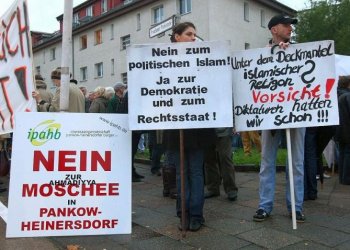
Protesters hold signs while demonstrating against the nearby Khadija Mosque shortly before its official opening ceremony on Oct. 16, 2008 in Berlin, Germany. The Khadija Mosque was the first mosque to open in east Berlin and provoked protests from nearby residents, who claim they fear an Islamization of their neighborhood.  (Sean Gallup/Getty Images)
Protesters hold signs while demonstrating against the nearby Khadija Mosque shortly before its official opening ceremony on Oct. 16, 2008 in Berlin, Germany. The Khadija Mosque was the first mosque to open in east Berlin and provoked protests from nearby residents, who claim they fear an Islamization of their neighborhood. (Sean Gallup/Getty Images)
When German Chancellor Angela Merkel said that attempts to build a multicultural Germany had “utterly failed” last October, it struck a chord with many in Europe where anti-immigrant sentiment has been steadily growing. Experts are worried about the trend and the increasing popularity of right-wing political parties that reflect the growing intolerance on the old continent towards its minorities.

According to Bashy Quraishy, Chair of the Advisory Council of the European Network against Racism (ENAR), and a member of the European Commission's High Level Committee on the Social and Labor Market integration of disadvantaged ethnic minorities, Europeans have a wrong perception of the word “immigrant.”

“They think that everybody who comes from outside Europe is an immigrant, while the real migration stopped in 1973, when Western European governments introduced restrictive measures to deter recruiting foreign labor.”

Quraishy, an Indian-born resident of Denmark, says he himself is also not an immigrant, but a European citizen. He believes that removing this perception will help improve the current situation, which has changed for the worse, in his view.

“Europe was a continent of peace and protection of minorities, rights, and democracy, but today, out of 27 EU member countries, 19 have right-wing governments. Many countries have very powerful and very visible racist parties, anti-Islam movements, numerous politicians openly advocate Islamophobia, causing many minorities to feel unsafe and afraid of what is happening.”

Roots of Discord

In Quraishy’s words, this didn’t start recently, but 500 years ago with the tide of colonialism.

“Most Europeans, governments and policymakers are still suffering from what I call ‘European colonial hangover.’ Some European countries had colonies, and they look at non-Europeans as a second-class people, as subhuman beings. And this mentality they had during colonial time, is still lingering on.”

In post-colonial times, Western European countries invited people from Turkey, Morocco, Pakistan, and the (now former) Yugoslavia over to work as cheap labor.

“The problem was that those cheap laborers were people, human beings. They needed education, means for living for their families, a better standard of life, so when Europeans discovered that, they didn’t know how to deal with it, especially when these human beings didn’t look like them,” says Quraishy.

In the economic slump of the 1980s, unemployment started to grow. Migrant workers, who till then were invisible to society, working in the private sector, also went to social centers asking for support from the authorities. Europeans started asking themselves: “Who are these people? Why are they standing with me in the line? I have worked all my life to contribute to this society,” says Quraishy.

“Then this jealousy and the feeling that foreign people are coming to their countries and using their social system started developing.

“When politicians are helped by the media to distribute those prejudices in society, then they took hold and became a public discourse.”

Quraishy says that the biggest milestone in forming anti-immigrant sentiment in Europe was 9/11. He says the whole debate on migration and on minorities shifted from immigrants’ social and economical issues to their culture and religion.

“If today you listen to media and politicians, they don’t discuss welfare, but ghetto problems, radicalism, [and] extremism. Now the discussion involves ‘cultural competition’ and ‘religious threat.’

The expert claims that this event has also put the Muslims in the spotlight, making them symbolic to a threat to Western society and values.

According to recent figures, roughly 5 to 7 percent of Europe’s population is Muslim, including countries like Albania and Kosovo where Muslims make up 80 and 90 percent of the population respectively. In Western Europe, Germany and France have the largest Muslim populations.

Quraishy says that Muslims themselves don't tend to talk about their religion in public discussion, but politicians and the media do.

He says that while he himself is not at all a religious person, he is also affected by this attitude. “I am a public figure, and people know who I am, so they don’t directly say in my face, but sometimes in newspaper articles when I criticize them, they even call me [a] fundamentalist. And I am even not a religious person. So this card of religion is played often to discredit a person.”

Lack of Integration

But Andreas Mölzer, member of European Parliament from the right-wing Freedom Party of Austria (FPO) sees a different picture. He says the most sensitive immigrant nationalities are the Turkish and the Africans. He says this is because they are culturally completely different and do not want to integrate in many fields. This often has to do with their Muslim faith.

The European politician is concerned that in Islamic societies there is no difference between state and religion. So if Muslims want to follow Shariah in Europe, full religious freedoms cannot be granted.

“Because of this we have to restrict [the] building of mosques and minarets. But it is important to mention that we have nothing against Islam and Muslim people. We, as FPO respect Islam, but just think that it is not compatible with Western life and society.”