Ancient Galaxy Evolution Fueled by Gas, Not Collisions

September 13, 2011 Updated: October 1, 2015

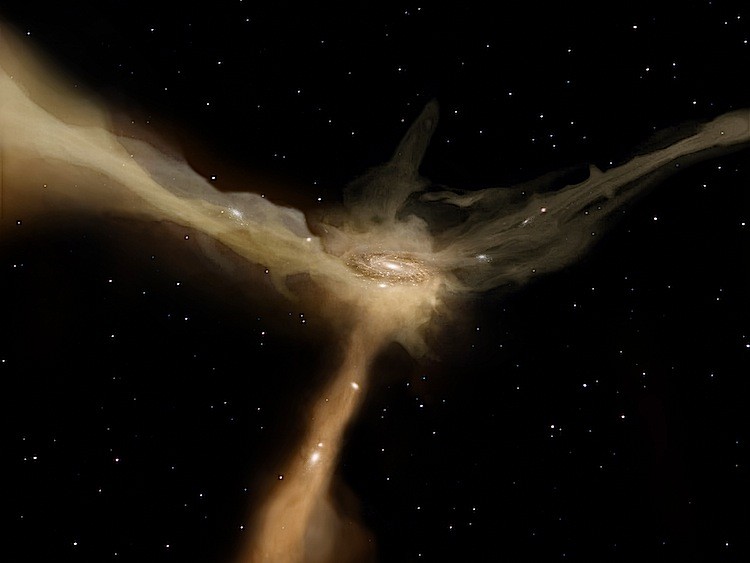
A galaxy accretes mass from rapid, narrow streams of cold gas. These filaments provide continuous flows of raw material to feed star formation. This process has never been directly observed and remains speculative. (ESA, AOES Medialab)
Star formation in the early universe was not primarily driven by galactic collision as previously thought, but by the quantity of gas present.

The European Space Agency’s (ESA) Herschel Space Observatory has collected data on more than 1,000 galaxies, covering 80 percent of the life of the cosmos, including infrared information.

The star birth rate peaked around 10 billion years ago when some galaxies were forming stars as much as 100 times faster than the present day. Nowadays, high rates are rare and typically triggered by galactic crashes, leading to the assumption that collisions were needed for rapid star birth.

Instead, an international team of researchers has found that the speed of star formation is associated with the amount of available gas—the raw material—irrespective of collisions.

"It’s only in those galaxies that do not already have a lot of gas that collisions are needed to provide the gas and trigger high rates of star formation," said David Elbaz at France’s CEA Saclay in a press release.

Scientists can now visualize ancient galaxies evolving according to the amount of surrounding gas, often at a more sedate pace than previously imagined.

"Herschel was conceived to study the history of star formation across cosmic time," said Göran Pilbratt, ESA Herschel Project Scientist, in the release.

"These new observations now change our perception of the history of the Universe."