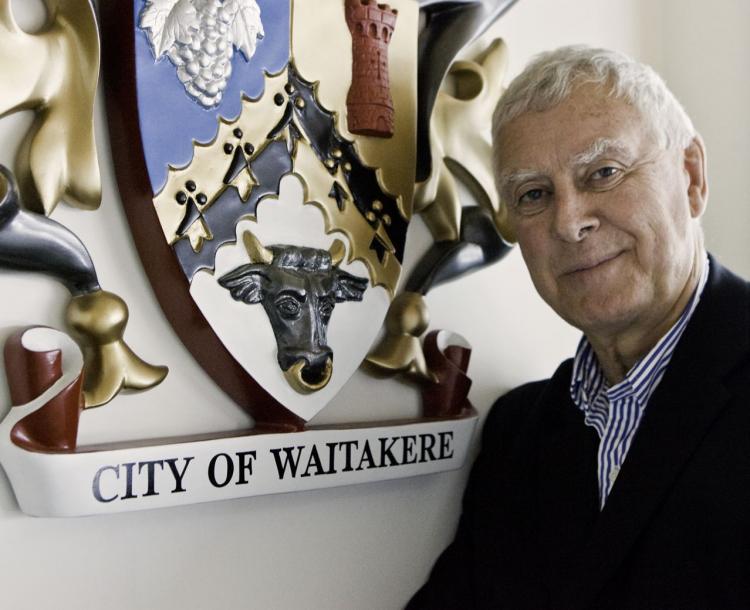
“Think of the wildest possible number in billions and you are going to get near to it," says Bob Harvey, mayor of Waitakere, commenting on the cost to ratepayers.
“When you take the debt of the five cities and then add the catastrophic costing for the leaky homes, we think there will be a rate rise of between maybe 20 and 30 percent.
“So initially there will be a savage realisation that that the 'super city' is not the panacea of all city ills.
“We would have preferred four cities of like size, like Los Angeles if you like, which are very workable and I think particularly sustainable.
“This one will be a different beast altogether.”
It is still too early to say how rates will be affected by the change, says Len Brown, Manukau mayor.
“I never really believed there was going to be a rationalisation or a lessening of the rate demand when you have amalgamations like this we are experiencing.
“It's going to make one very, very big bureaucracy.
“I think that anyone saying they are going to slash the rates at this point and time would have to be seriously questioned,” says Mayor Brown.
There is no basis for claims that rates will rise under the new “Super City,” says Rodney Hide, Minister for Local Government.
“It will be the Auckland Council's decision, after consulting with the Auckland public, that will determine its expenditure and required income through rates and other sources,” he said.
Consultants for the Royal Commission have estimated savings of $277—$574 million for their preferred model.
“However, the Government's model of a unitary authority with local boards provides for a better integration of services which … will result in even greater efficiency gains than those identified for the Royal Commission proposal.”
But, Peter McKinlay, Local Government Centre Director at Auckland University, says evidence shows that the burden on ratepayers rarely falls following metropolitan amalgamations.
“You will find that there are a number of claims that restructurings in cities such as Toronto and Ottawa resulted in significant savings, he says.
“But when you investigate those you will find that these are claims by the responsible official/politicians and that the work of independent researchers produces significantly different outcomes.”
“Every bureaucracy’s first goal is to preserve itself and grow, say economists Dr. Jeff Weber and Lindsay Saunders.
In their submission to the Royal Commission on Auckland Governance they described the Super City bureaucracy as “a large monopoly over services and the decision-making … with little chance of accountability or transparency.”
“Reducing or eliminating programmes is not exactly a strong feature of any bureaucracy. We expect a Super City bureaucracy to require Super Rates to support it,” they said.
The Auckland Council Bill was passed by parliament under urgency yesterday by 64 votes to 58 with much of the work over infrastructure still to be worked out. Elections for the newly formed Auckland City Council are expected to take place in October 2010.