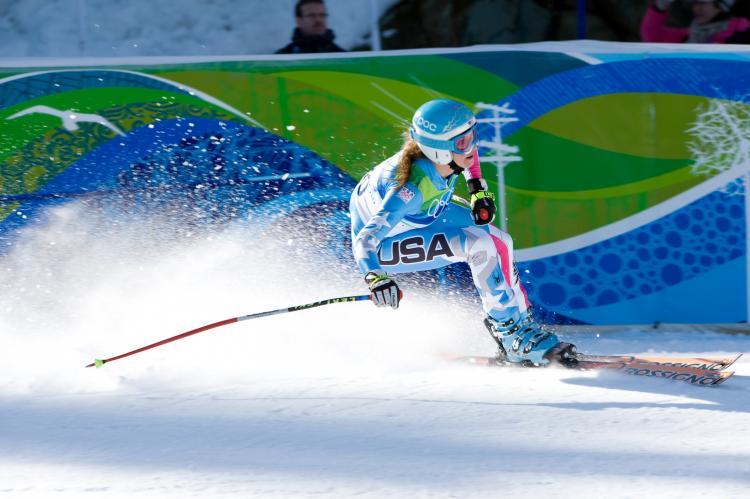
VANCOUVER, Canada—Most would think that at a higher altitude, athletes would perform worse due to lack of oxygen, but an exercise physiologist has said that the lower air pressure at high-altitude venues can actually help some athletes.
According to Dr. Robert Chapman, an expert in altitude training at Indiana University, the altitude of a sports venue can have a significant impact on performance. At a higher altitude, a reduction of air density of 3 percent per 1,000 feet can result in faster skiing, snowboarding, and skating due to less aerodynamic drag.
“Many athletes perform thousands upon thousands of moves so they get a certain motor pattern ingrained,” said Chapman in a press release. “In an endurance sport such as cross-country skiing or biathlon, for competition at altitude it takes about 10–14 days to adjust. For a skill sport, it’s harder to judge how long it will take to acclimate to the reduced air density at altitude. Hopefully, these athletes have incorporated this into their training, maybe in the last year or for a period of time, not just the two weeks leading up to competition.”
The Vancouver 2010 Winter Olympic Games runs from Feb. 12 to 18, and the Paralympic Games runs from March 12 to 21. Most of the ice events are at nearly sea level. Sledding (bobsled, luge, and skeleton) events are at around 2,600 feet, and downhill skiing events are at about 5,000 feet.
Chapman said fans cannot expect too many record times in speed skating events due to the low altitude and great air resistance facing the athletes.
Chapman and his co-authors noted in their paper that the world record for men and women in all long-track speed skating events from the 500 m to 10,000 m races were set in Olympics held in either Calgary 1988 at an altitude of 3,400 feet or Salt Lake City 2002 at an altitude of 4,300 feet. No athlete broke any record in Turin 2006 at an altitude of 784 feet.
“The general thought is that altitude slows you down because you have less oxygen going to your muscles,“ Chapman said. ”But at altitude, just as it is easier to hit a home run in the thin air of Denver, speed skaters in Calgary and Salt Lake City could skate faster, move through the air faster, because there was less drag.”
“Eight years after Salt Lake City, we have natural improvements that you'd expect to see involving training, coaching, and technology, but we won’t see many records in Vancouver. It doesn’t mean the athletes are worse, if anything they’re probably better. It’s the effects of altitude on athletes’ times.”
According to Chapman, Air density particularly acts up on ski jumping, requiring athletes to change the angle of their lean in accordance with the altitude.
Recommendations
Chapman and his co-authors listed the following recommendations concerning training and performing at altitude:
1. Allow extra time and practice for athletes to adjust to changes in projectile motion. Athletes in sports such as hockey, shooting, figure skating, and ski jumping may be particularly affected.
2. Allow time for acclimatization for endurance sports: Three to five days if possible, especially for low altitude (1,640–6,562 feet); one to two weeks for moderate altitude (6,562–9,843 feet); and at least two weeks if possible for high altitude (more than 9,843 feet). Chapman said altitude affects breathing, too, with breathing initially being harder at higher altitudes.
3. Increase exercise-recovery ratios as much as possible, with a 1:3 ratio probably optimal, and consider more frequent substitutions for sports where this is allowed, such as ice hockey. Recovery refers to the amount of time an athlete eases up during practice between harder bouts. If an athlete runs hard for one minute, following this with three minutes of slower running would be optimal before the next sprint. The recovery period gives athletes more time to clear lactic acid buildup from their muscles.
4. Consider the use of supplemental oxygen on the sidelines in ice hockey or in between heats in skating and Alpine skiing to help with recovery. Chapman said this helps calm breathing, which can be more difficult at altitude.
5. Living at high altitudes while training at low altitudes can help athletes in endurance sports improve performance at lower altitudes.
To read the research paper,please click here