Asian antiques have long been a subject of interest for Paul Haig, an expert in jade oriental antiques. Inspired by his parent’s appreciation of Asian society, Haig’s interest in oriental art and jade has grown to more than a mere hobby. As the owner of Haig’s of Rochester Fine Jewelry, an antique and jewelry store in Rochester, Michigan, Haig has been specializing in gem stones for over 30 years.
Spending time in the backrooms of the Smithsonian’s mineralogy department and mentored by experts in the industry, Haig developed a fascination for stone cutting as a child. At only 14, he was already selling stones and later went on to travel across the United States working at gem shows as an assistant helping to sell opal. In 1973, by the time he graduated college, he had already gained the knowledge he needed to start his own business. “I gave it a summer and I didn’t look back,” said Haig.
Types of Jade
When referring to jade, there are two types to consider—nephrite and jadeite. Both are highly prized and continue to command attention from collectors and art lovers. Of the two, nephrite is most often found in the old Chinese carvings. Haig notes that the value of nephrite pieces increases depending on the color, size, age, and quality. “White jade is currently very popular in carved pieces with the Chinese,” says Haig.
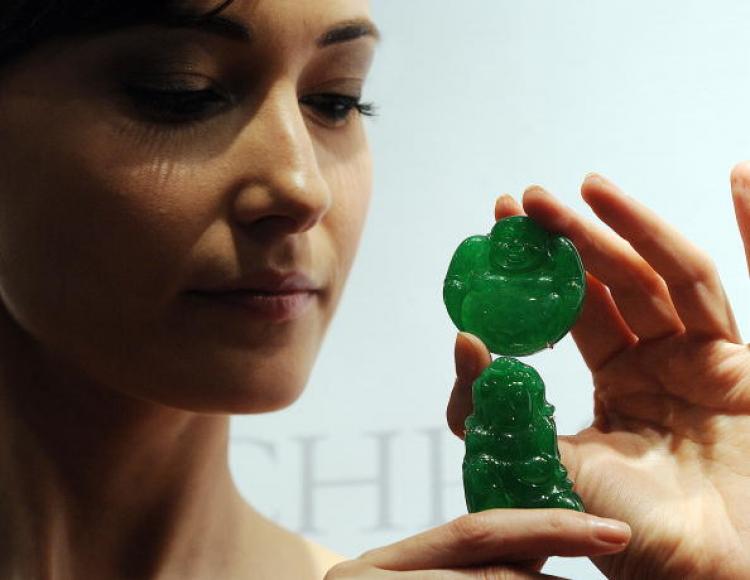
As for jadeite, Haig notes that it wasn’t until the 19th century that jadeite carvings started to surface, with the material primarily originating in Burma. “Some phenomenal things are carved from jadeite jade,” he said. Among the most expensive and valuable in jadeite jade is a grade known as imperial; the finest of all jades. Its color is limpid, often a little lighter than emerald green and semi translucent, resembling a green jelly. However, Haig warns that the term imperial is often applied to specimens that don’t fit the criteria. He has seen very few pieces that actually earn this distinction.
Market Value
According to Haig, an influx of Chinese customers looking to buy back their own jade has phenomenally increased its value on the market. “A lot of great pieces were taken out of Asia, China in particular between 1840 and 1940,” he says.
“Now the flow is reversed. There are a lot of Chinese dealers coursing through the United States at antique shows, antique stores, and so on. I get a number of them at my store.” Haig told of a piece at one show that passed four dealer’s hands before it left the floor, each time selling for more money.
“This happens quite often,” says Haig. “There’s a lot of competition for buying fine jade right now. They are going for a lot more than five years ago. I would say that they easily tripled in value from 10 years ago.” In the last month alone, Haig says he sold about $50,000 worth of jade. He assumes that most of that has gone back to China.
Haig suspects many people buying jade right now are doing so on speculation. “They’re buying it because they realize that the Chinese market in their opinion is going to get much stronger. The Chinese are going to be buying back their own at an increasing rate,” says Haig.
Looking for the Right Piece
When selecting a piece of jade, Haig explains how he examines quality first and foremost. Next, he looks at its age. He notes there are a growing number of reproductions on the market, generally newly made pieces in old styles.
“They’ll cut them modernly and then they’ll refinish the surface entirely using old methods,” says Haig. In his experience, there are many reproductions done so well that they’re virtually indistinguishable from authentic specimens.
Some even argue these high quality reproductions are worth just as much as the older pieces, but Haig disagrees. “It’s like having a fine painting; a Monet, copied. It’s not done by the original artist of the period,” says Haig. He has also observed a lot of reproductions sold as old pieces at some shows.
While a careful examination can identify a replication, Haig argues that reproductions are getting harder to distinguish. “They’re taking old pieces and copying them very carefully,” he says, noting that modern technology has played a major role in creating a convincing copy.
Haig has also noticed a lot of enhanced jade on the market. Even perusing New York’s jewelry district one can see that it’s quite prevalent. Old techniques for faking fine colored jade are making a comeback.
In a recent show in Santa Fe, Haig noticed one gentleman with a very dark piece of jade that had been hollowed out. There is a lot of older, hollowed out jade as well, as this technique was also used in Asia in the past. Hollowing it out will improve its translucency when the color is too dark.
The Joy of Discovery
Haig has done a lot of traveling to Asia, acquiring different pieces throughout the years, but “there are still pieces to be found,” he says. “I saw some great pieces of Asian art in Argentina. It’s a world market.” Haig says he is increasingly more focused on jade due to its good market conditions.
Discovering new pieces may be exiting, but Haig warns being careful. He has noticed many jades labeled antique that are in actuality modern pieces. “There are a lot of pieces at auctions that are questionable in age,” says Haig. “[Some] I know aren’t old if I look at them but they’re being sold as old and are commanding pretty good prices,” he describes. “In jade and Asian antiques, there’s a lot of stuff that I’m offered that looks good until you look at it extremely carefully.”
Future Prospects
Haig says he sees an interesting future for the Asian antiques market and especially in gem stones. He predicts there will be many discoveries coming out of collections. “Things go in cycles,” says Haig, noting the current high end of the cycle. “It’s defiantly going upward right now,” he continued. “As the economy worldwide comes back, I see that people are seeing objects [such as] jade, as a good investment. Things are always changing.”