Alien World Exhibits Extreme Weather

September 12, 2011 Updated: October 1, 2015
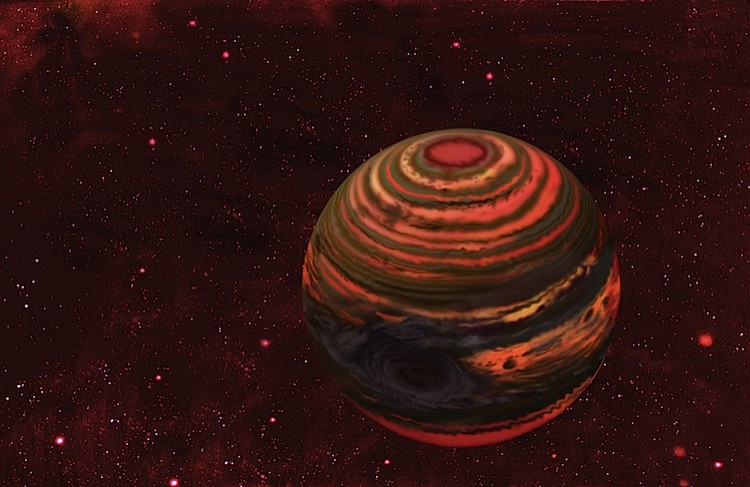
Astronomers have observed extreme brightness changes on a nearby brown dwarf that may indicate a storm grander than any seen yet on a planet. (Jon Lomberg)

Intense fluctuations detected in the brightness of a nearby brown dwarf could be evidence of a severe storm, and could yield insights into weather systems on exoplanets, a recent study found.

Over the course of several hours, a team of astronomers acquired multiple images of a brown dwarf named 2MASS J21392676+0220226 (2MASS 2139 for short) during a survey of nearby brown dwarfs—stars with intermediate masses between a planet and a red dwarf.

"We found that our target’s brightness changed by a whopping 30 per cent in just under eight hours," said study lead author Jacqueline Radigan at the University of Toronto in a press release.

"The best explanation is that brighter and darker patches of its atmosphere are coming into our view as the brown dwarf spins on its axis."

Based on modeling, clouds are thought to form on giant planets and brown dwarfs when silicate and metal dust grains attract water vapor and cause condensation.

"We might be looking at a gigantic storm raging on this brown dwarf, perhaps a grander version of the Great Red Spot on Jupiter in our own solar system, or we may be seeing the hotter, deeper layers of its atmosphere through big holes in the cloud deck," said co-author Ray Jayawardhana at the University of Toronto in the release.

Radigan said that measuring the rate of change in brown dwarf clouds could allow atmospheric wind speeds to be calculated and explain how these forces arise in brown dwarf and planetary atmospheres.

The paper is called "High Amplitude, Periodic Variability of a Cool Brown Dwarf: Evidence for Patchy, High-Contrast Cloud Features," and will be published in The Astrophysical Journal.

Read the paper at http://bit.ly/pqlqGd