2011 Petit Le Mans—Europeans Invade the Top Ranks

September 26, 2011 Updated: October 2, 2015

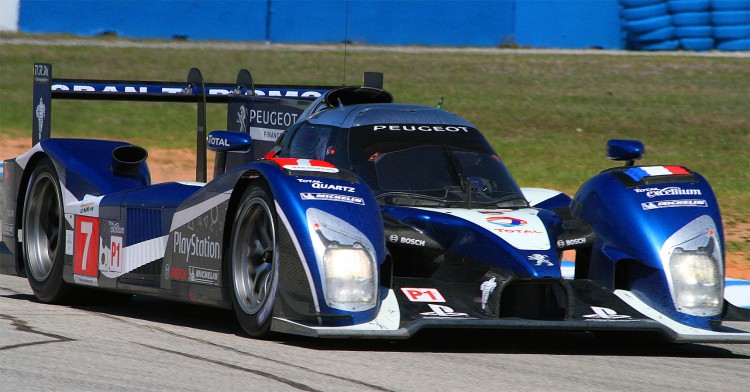
Peugeot has won everything except Le Mans this year, and certainly plans to win Petit Le Mans for the third year running. (James Fish/The Epoch Times)
The British are coming! So are the French, and the Germans! In fact, 65 percent of the top two classes at the 2011 Petit Le Mans will be fielded by teams from Europe, here to overwhelm America’s fastest on their home soil.

And that is not a bad thing.

Petit Le Mans, the American Le Mans Series’ annual ten hour/1000-mile endurance race, attracts the fastest cars from all around the world. For 2011 it will be run jointly with the Intercontinental Le Mans Cup series, so the best of the Content face the best of the former colonies.

This year’s race, held at the Road Atlanta racetrack this Saturday, will feature 52 of the fastest sports cars on the planet racing in five classes, from the most exotic purpose-built prototypes to modified street cars with wings and wide racing slicks.

Somewhat sadly, the European teams, part of the Intercontinental Le Mans Cup, dominate the sharp end of the field; America won’t be represented on the podium unless multiple disasters wipe out the top two teams, Peugeot and Audi.

The European auto-building giants, racing in the LMP-1 class, should be in a class of their own. Using turbocharged 3.7-liter diesel engines pumping out more horsepower and torque than any other cars on the grid, the hyper-exotic, hyper-expensive racing machines are guaranteed to win overall. In Monday’s test session the fastest diesel was three seconds quicker per lap than the fastest non-diesel competitor.

The other factory-supported LMP1 car, the Aston Martin AMR/Lola, runs on E-10, gasoline with 10 percent ethanol. Despite having a factory budget behind it, this two-year-old doesn’t have a diesel engine; the rules favor diesels, so the Aston won’t win.

The Rebellions have proven to be the fastest in the gasoline class on many European tracks. (James Fish/The Epoch Times)
Same for the rest of the European P1 cars, the Rebellion Lolas with Toyota powerplants or the Oak Pescarolos with Judd engines. These teams know from a season’s head-to-head battles with the diesel giants, that they will be racing for leftovers.

The #15 Oak Pescarolo will be contesting the gasoline-powered portion of the P1 class. (James Fish/The Epoch Times)
What about the American teams? Well in Tuesday’s test session, the fastest U.S.-based team was the #20 Oryx/Dyson Lola Mazda, 3.8 seconds off the fastest diesel lap. This car uses a two-liter, four-cylinder turbocharged motor burning Isobutanol, an alternative to gasoline which, like ethanol, produces lower greenhouse gas emissions, and is more environmentally friendly to produce. Isobutanol also provides a potent kick; the Oryx/Dyson’s sister car won the 2011 ALMS championship using this earth-friendly fuel.

The #20 Oryx Racing Dyson Lola Mazda will be one of four LMP-1s defending American racing. (Regis Lefebure/Dyson Racing)
Still, the rules favor the diesels, whether inadvertently or because the overall sanctioning body, the ACO (Automobile Club de l'Ouest,) wants to protect the multi-year, multi-billion-euro investments of the major manufacturers. Barring multiple disasters, either Peugeot or Audi will win (odds favor Peugeot, as they  have dominated European ILMC races so far this season.)

The Sebring-winning Oreca Peugeot will be back to try to capture a second American victory. (James Fish/The Epoch Times)
Why is this a good thing?

Because one premise of the American Le Mans Series is that it brings the most advanced, most exotic, most experimental cars on the planet to test their technologies in all-out competition. Experimental lower-emission fuels, different hybrid systems, exotic materials … these are cutting-edge racing machines, pushing the limits of engineering and performance.

Oak Pescarolo is bringing two cars, the #24 and the #15, to increase its odds. (James Fish/The Epoch Times)
No American car companies choose to invest in the top-tier machines—preferring to focus on modified street cars—but North American racing fans want to see the best of the best.

Racing as well as technology transcend borders. The fastest, most technologically advanced car can come from everywhere, and it attracts people because of its qualities, not because of its nation of origin.

The Corvettes will be tough to beat for teams from either side of the ocean. (James Fish/The Epoch Times)
Sure, Americans want to root for Americans; but racing fans want to see the very best, and when those quick, quiet diesels flash by at over 200 mph, no one will care what country they come from.

Besides, we will beat the Europeans in GT anyway; Monday no one could top the times of the Corvettes.

The 14th running of Petit Le Mans will start at 11:30 a.m. on Saturday, October 1 at the Road Atlanta racetrack in Braselton, Ga. Tickets are available through the Road Atlanta website or via phone at 770.967.6143, or 1.800.849.RACE. Tickets will also be available at the gate on race day.