
2010 Vuelta a España at Halfway

September 7, 2010 Updated: September 7, 2010

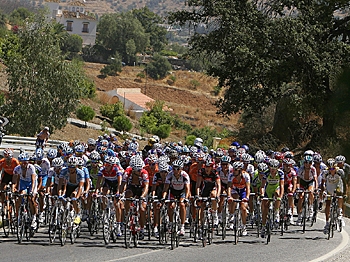
The peloton rides during Stage Three of the Vuelta a Espa&#241a. (Jose Jordan/AFP/Getty Images)
With 10 of 21 stages run, the 2010 Vuelta a España, third of three Grand Tours of the professional cycling season, is heading into the hardest stages.

This year’s Vuelta might be the hardest of season’s Grands Tours, covering 3,353 kilometers (2,083 miles) with 11 mountain stages (the Tour de France had only six) including six punishing mountaintop finishes.

The Grand Tours—the Giro d’Itlia, the Tour de France, and the Vuelta a España, are 21-day races which cover thousands of miles in and around the host nations. A win in a Grand Tour can make a career. Even a stage win can mean more sponsorship, offers from better teams, and higher salaries, not to mention, unequaled prestige.

The Vuelta, coming at the end of the season, challenges riders who have already pounded their way over thousands of miles of road, and climbed countless mountains—“More, more,” it calls to them. “Prove you can do more.”

Answering the call were 198 riders on 22 teams, but crashes, illness, and fatigue have shrunk that number.

Alessandro Petacchi won Stage Seven but retired after a crash later. (Jose Jordan/AFP/Getty Images)
Alessandro Pettachi, who won the sprinter’s competition at the Tour de France, crashed heavily and retired early from the Vuelta. The entire team Sky squad dropped out with a stomach ailment.

Plain bad judgment has also claimed two riders. Saxo Bank’s Andy Schleck, who finished second in the Tour de France, and teammate Stuart O’Grady, were banished by their team boss after sneaking out for a forbidden pint or two after dinner.

Philippe Gilbert of Omega-Pharma-Lotto wore red for several days. (Jose Jordan/AFP/Getty Images)
More retirements are sure to come. For the next several days, the Vuelta heads into the mountains for its hardest stages.

Stages 14, 15, and 16 end with Beyond-Category mountaintop climbs—climbs so steep and hard they exceed cycling’s rating system. With eight climbing stages in a row, it is likely that several of the sprinters will not be able to hold on for Stage 18, the final sprint stage.

Joaquin Rodriguez of Katusha looks back as he crosses the finish line of Stage Eight to see his margin over Igor Anton. It was not enough, and Anton earned the red jersey. (Jose Jordan/AFP/Getty Images)
After a rest day, a time trial, and a sprint stage, the Vuelta offers up two more mountain stages, the last ending with another Beyond-Category climb. Any rider who can drag himself over 2000 miles of road to reach the last stage should be rewarded, but off course, there can only be one winner.

Though the Vuelta is half over, no real favorite has emerged. Katusha’s Joaquin Rodriguez has finally take the red leader’s jersey in stage ten, after trying for three days—but only by two seconds. Rodriguez admits he is weak in the time trial, and has to rely on his climbing to open a gap—which has not done so far.

Eskaltel-Euskadi's Igor Anton celebrates winning Stage Four of the Vuelta a Espa&#241a. (Jose Jordan/AFP/Getty Images)
Euskatel-Euskadi’s Igor Anton has been in fine form, winning a stage and wearing red, but while he has been good, he has not been much better than everyone else.

Saxo-Bank’s Fränk Schleck announced that he wanted to win the Vuelta, after crashing out of the Tour de France in Stage 3. But he is not even in the top ten right now, and his best climbing partner, his brother, is out of the race.

Liquigas is well represented, with Vincenzo Nibali residing strongly in third place, saving himself for the tougher stages. His team showed its strength in the Giro d’Italia, and could take the win here too.

Any of these could win, or perhaps some relative unknown who has hidden his crazy climbing skills until now. Whoever it will be, he will have worked harder and suffered more than most people could conceive. Whoever wears the red jersey in Madrid, will have earned it.