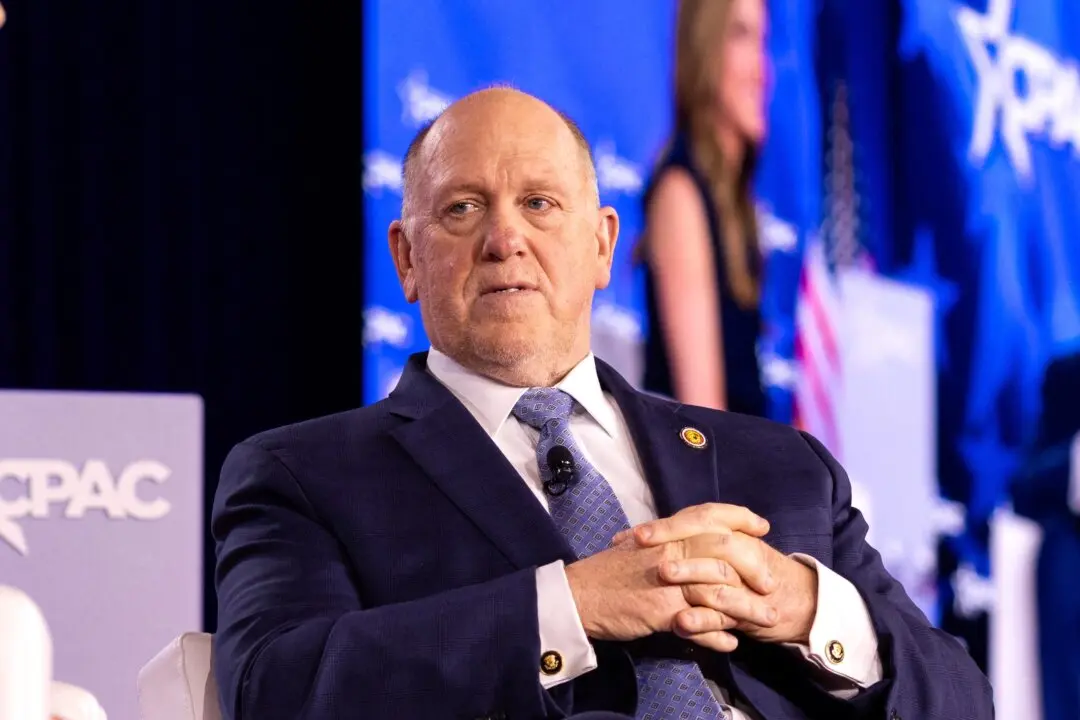
Mattias Guilotte is the co-founder of Mancx, a Sweden-based company for buying and selling information. (Courtesy of Mattias Guilotte)
Imagine for a moment a world where business is done directly between people, without middlemen, and all businesses—no matter how large or small—are international and on an equal playing field.
There are a few things stopping this from happening. Beyond money for advertising keeping the wheels of research and development ever turning, big business has an ace up its sleeve through access to information; business intelligence. For the right price, it can find what people want, where they want it, and the quickest way to get it there—while the small guys are stuck playing a game of chance.
Yet, Mattias Guilotte believes this doesn’t need to be so.
It was a few years back that he and a friend, Henrik Dillman, were having a few beers. Guilotte had recently read a book by Charlie Stross, called “Accelerando.” The conversation moved toward the book, and eventually to the occupation of its main character who made a living selling information.
“We said it’s kind of weird that you can buy anything online, except information,” Guilotte said.
This thought went a bit further when they realized they both still used Google when doing research for work, with mixed results. If that doesn’t work, they turn to people in their networks, also with mixed results.
“So I was going down the road and having really grand thoughts, like who is the sorting manager for this and that company, and who are the main people in Germany telecom, in Serbia, etcetera,” Guilotte said.
It was then, Guilotte said, that inspiration hit, and he realized “There is a big opportunity now for democratizing the flow of information.”
Now the dream is a reality, and Guilotte and Dillman are the co-founders of Mancx, named after Manford Mancx, the main character in “Accelerando.” And just like that character, they now buy and sell information, through the Sweden-based company.
This is done in a way much different from what’s currently out there. While companies specializing in business intelligence conduct research themselves and work on massive paychecks, Mancx taps into the minds of the world directly—crowdsourcing information with a peer-to-peer strategy similar to that of eBay or Kickstarter.
Let’s say you want to start selling bikes in a suburb of Paris. You could make a post on Mancx offering $150 to anyone who can tell you the cheapest distributors for parts. Or maybe you want to know where the competition is, or whether laws would block you from selling locally as a noncitizen. Anyone who knows the answers can take up the bid, tell you what they know, and collect the payment.
“Our mission is to make any and all information available, at the right price,” Dillman said.
Now, there are already similar websites out there. Quora, for example, lets anyone post questions about nearly anything, and encourages experts on the subjects to offer answers. Yahoo! Answers has a similar platform. Yet, what sets Mancx apart is the idea of charging for information. This is meant mainly as a way to ensure quality, both in terms of questions that are posted, and in terms of answers received.
“I think we have seen some really good requests for information you can’t find anywhere else,” Dillman said.
One of the first questions posted on the site was of someone looking for companies to distribute IT equipment in Brazil. It turned out that Brazil has specific regulations on importing used IT equipment, to avoid becoming a dumping ground for it.
This type of information, Dillman said, is otherwise difficult to find, and often comes only through a few rounds at the school of hard knocks.
“Usually the big guys are sitting on all the information and you’re basically out maneuvered if you’re not in the top 5 or 20, depending on what type of industry it is,” Dillman said.
“But we definitely see something changing,” he said. “All of a sudden we see this move to a group market economy, where any small business in the world can actually exchange.”
He said that with the sudden shift in the global economy, which gives even the little mom-and-pop shops a chance at the global market, he was surprised that a platform like Mancx had not been invented already.
It’s timely, also. “I think just three years ago this wouldn’t have been possible,” Dillman said, noting that social networks, cloud computing, and even legal channels opening up for global online businesses, have made this possible.
“I think we’re going to see a shift in the power from big, multinational corporations, to smaller and smaller companies,” he said. “I think the big corporations are going to see increasing competitive pressure from smaller and smaller companies that are able to deliver a niche products.”
“What we really see though, is the growth of a peer-to-peer economy,” he said. “I think the boundaries will blur there.”
The concept of peer-to-peer economies, he mentions, is based around people doing business directly with each other—a concept already coming about through websites like eBay and Amazon, which let nearly anyone post products for sale.
“Frankly, market businesses come and go, but Paypal is still around,” he said. “I think we’re aiming for the same thing when it comes to global trade, when it comes to information and knowledge.”
The vision doesn’t end there, though. Dillman hopes to grow Mancx into a platform where people can also trade intellectual property—things like sound files, product designs, and PowerPoint presentations introducing various concepts.
But, as with all peer-to-peer platforms, what it’s used for will ultimately come down to the community. Dillman said that as time goes by, “We’ll see what people actually use it for.”
The Epoch Times publishes in 35 countries and in 19 languages. Subscribe to our e-newsletter.


.png)